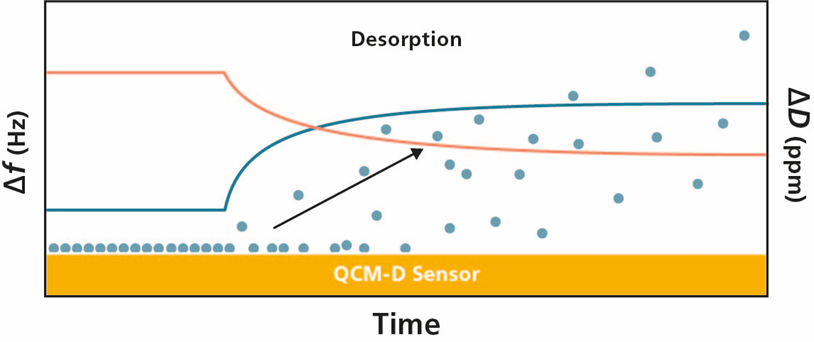
The frequency shift (Δf) measured by QCM-D reflects mass change at the surface. An increase in Δf indicates mass loss, and vice versa. When molecules or material desorb from the sensor surface, the sensed mass will decrease and cause an increase in Δf. The magnitude of the shift is related to the mass lost from the surface.
The Dissipation shift (ΔD) provides information about the viscoelastic properties of the layer at the surface and reveals how this changes as material desorb and is no longer sensed. As a rule of thumb, the higher the D, the softer and/or thicker the layer
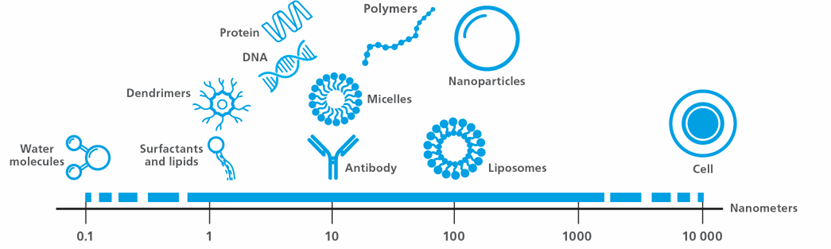
The detection range of QSense technology spans from nanometers to micrometers, depending on the viscoelasticity of the applied film or medium. Molecules and entities that are typically analyzed are for example lipids, proteins and other biomolecules, surfactants, polymers, nanoparticles and cells.