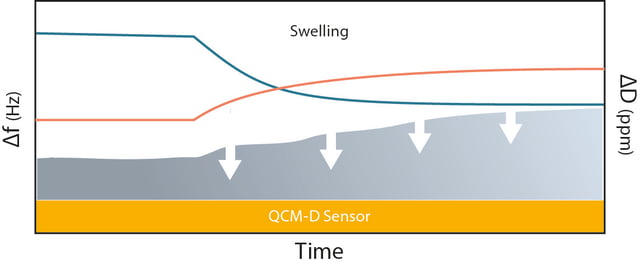
The frequency shift (Δf) measured by QCM-D reflects mass changes at the surface. A decrease in Δf indicates mass uptake, and vice versa. The mass sensed by QCM-D is the so-called 'hydrated mass,' which includes both the molecules and the coupled solvent. When a layer at the sensor surface swells, for example due to uptake of solvent or molecules from the bulk liquid, there is an increase in the total sensed mass. This results in a decrease in Δf.
Additionally, if molecules at the surface undergo conformational changes, the amount of coupled solvent can also change. Even if the molecular mass remains constant, swelling due to increased solvent coupling will decrease Δf, while collapse, crosslinking, or molecular rearrangement will reduce the coupled mass, increasing Δf. The magnitude of the frequency shift provides valuable insight into swelling behavior and hydration dynamics at the nanoscale.
The Dissipation shift (ΔD) provides information about the viscoelastic properties of the layer at the surface. As a rule of thumb, the higher the D, the softer and/or thicker the layer. A typical scenario where there is an increase in mass, i.e. decrease in f, shows an increase in ΔD. This is due to the fact that an increase of coupled solvent generally means a more hydrated layer, which is softer and/or thicker than before the mass change.
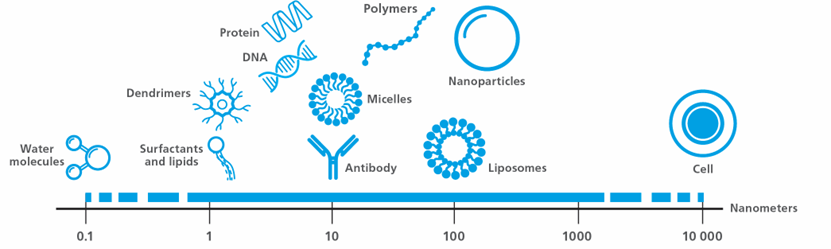
The detection range of QSense technology spans from nanometers to micrometers, depending on the viscoelasticity of the applied film or medium. Molecules and entities that are typically analyzed are for example lipids, proteins and other biomolecules, surfactants, polymers, nanoparticles and cells.