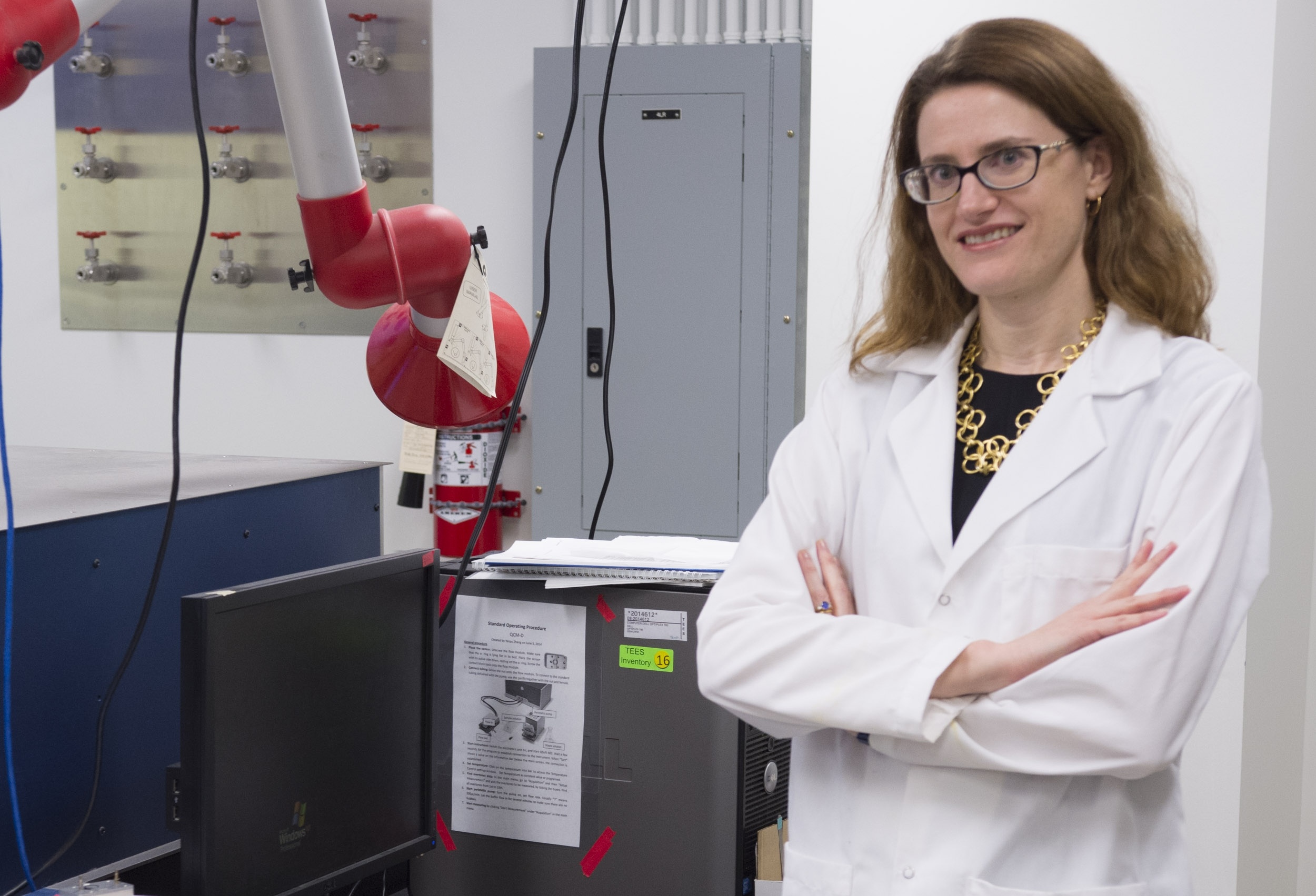
My team has two main focus areas. We’re exploring polymers for plastic power, enabling flexible or structural batteries and capacitors. We’re also investigating polyelectrolytes, which are integral components in smart surfaces and coatings.
What exciting developments are taking place in your research areas?
Electroactive polymers are promising candidates for electrodes in batteries and capacitors, and stand to revolutionize the field of flexible energy and power. Wearable energy storage is closer than we think! Our group specializes in the design and synthesis of polymer electrodes that store charge through rapid redox reactions such as polyaniline and other derivatives. When it comes to polyelectrolyte complexes, the major questions relate to how ions affect the complexes. Here, we specialize in how oppositely charged polymers interact and respond to external stimuli (temperature, pH, salt). We’re conducting response studies using the QSense QCM-D tool to help solve the puzzle.
Wearable energy storage is closer than we think!
How are you using Qsense?
We use the high temperature model that allows us to investigate polyelectrolyte complexes and their response to temperature. We’re also using the electrochemistry module so we can run our standard electrochemical measurements at the same time as we run the QCM-D. The main benefit is that we can monitor the mass change of our system in real time. I can tell you that for every electron moved, this amount of mass changed. That’s powerful. You can’t really get that with any other system
What advice do you have for up-and-coming surface scientists?
My advice is you really need to understand the instrument you are working with, so if you have the opportunity to go to training courses or use online webinars, you really need to do those. With QCM-D experiments, you sometimes get results that are difficult to interpret - so you need to run controls and replicate the experiments. You need to make sure you really understand the instrument.
Learn more about Dr Lutkenhaus and her research on her research website




