
Environmental interfaces — where contaminants, particles, natural organic matter, membranes, sorbents, coatings and biofilms interact — are central to the performance of water treatment, purification, remediation and environmental monitoring technologies. These interactions govern processes such as pollutant capture and release, membrane fouling, particle deposition, biofilm formation and material degradation, making them essential to understand and control. QSense® QCM-D enables real-time, label-free analysis of surface and interface phenomena at solid–liquid interfaces. By providing insight into adsorption, desorption, layer build-up, removal and viscoelastic properties, this versatile technology supports the rational design of more selective, fouling-resistant and durable environmental materials and systems — from advanced water purification and PFAS remediation to antifouling strategies, sorbents and protective coatings.

Water Purification & Treatment: Membrane fouling, filtration performance, desalination,
organic matter adsorption, and cleaning efficiency.
PFAS & Pollutant Remediation: Sorbent screening, contaminant adsorption/desorption,
surface selectivity, and regeneration strategies.
Microplastics & Nanoparticles: Particle deposition, retention, release, and transport
on environmental surfaces.
Wastewater & Biofilm Systems: Biofilm formation, EPS deposition,
carrier surface conditioning, and biofouling control.
Environmental Materials & Coatings: Antifouling surfaces, protective
coatings, functionalized sorbents, and materials for environmental
sensing.
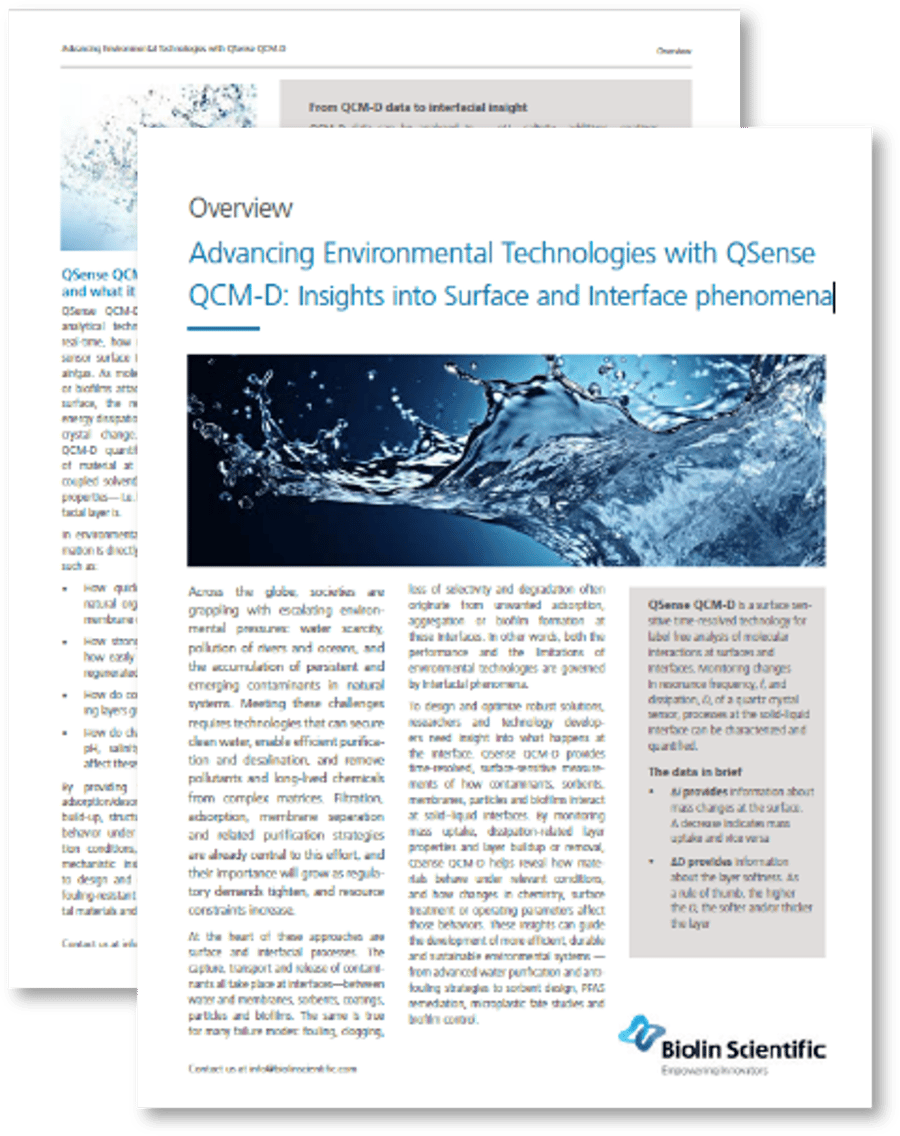
Download the overview to learn more about how QSense QCM-D analysis can be used to advance environmental technologies
-1.webp?height=480&name=biolin-water-on-hydrophobic-fabric%20(1)-1.webp)
QSense is a surface-sensitive technology that detects molecule - surface interaction at the nanoscale. It can be used to analyze phenomena such as adsorption, desorption, and structural changes of surface adhering layers.




Quartz Crystal Microbalance with Dissipation monitoring (QCM-D) is a real-time, surface sensitive technique for analyzing surface-interaction phenomena, thin film formation and layer properties.