In our previous post on amperometry, we explored how controlled potential conditions allow us to study electrochemical reactions in real time. However, "potential" is not an absolute value; it is a measurement of the tendency of electrons to move from one point to another. To define that potential accurately, we need a stable, unchanging "zero" or reference point. In the lab, that stable ground is provided by the Reference Electrode.
In this post, we will briefly touch on the concept of potential as a metric for reaction spontaneity before shifting focus to what the choice of reference point practically means for the accuracy and physical insights of our experiments.
To understand why electrons move, we must look at the energy landscape of the system. The electrode potential is the most critical variable in any experiment because it acts as the thermodynamic pressure that dictates the speed of the reaction, which products are formed, and how those products are distributed.
Every electrochemical system strives for a state of balance. This equilibrium is reached when the electrochemical potential (μi) of a mobile species is identical across all contacting phases, such as the electrode and the electrolyte. This potential is not just about chemical concentration. Instead, it is the sum of the species' chemical environment and the inner electric potential (ø) of the phase. When these potentials are unequal, a thermodynamic drive causes charge to move until equality is restored.1
However, an important concept in electrochemistry is that the absolute potential of a single electrode—the inner electric potential difference—cannot be measured or calculated in isolation. We can only ever measure the difference between two points.
Because we cannot measure absolute potential in isolation, we must introduce a reference electrode. This is a specialized electrochemical cell designed to maintain a constant, well-known potential. While the Working Electrode (where your reaction happens) changes its potential based on your experiment, the reference electrode remains a "fixed point" on the map. This is important, as like I mentioned earlier, in electrochemistry all potentials are inherently relative.
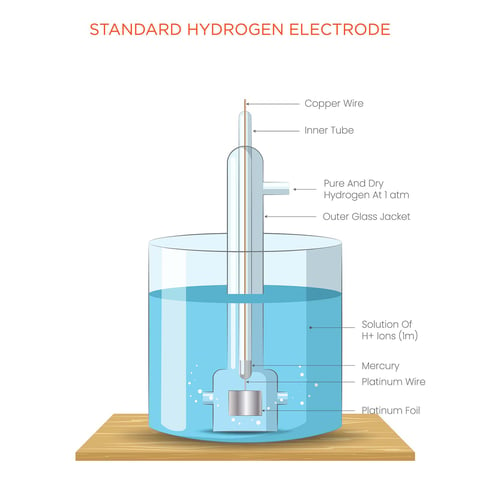
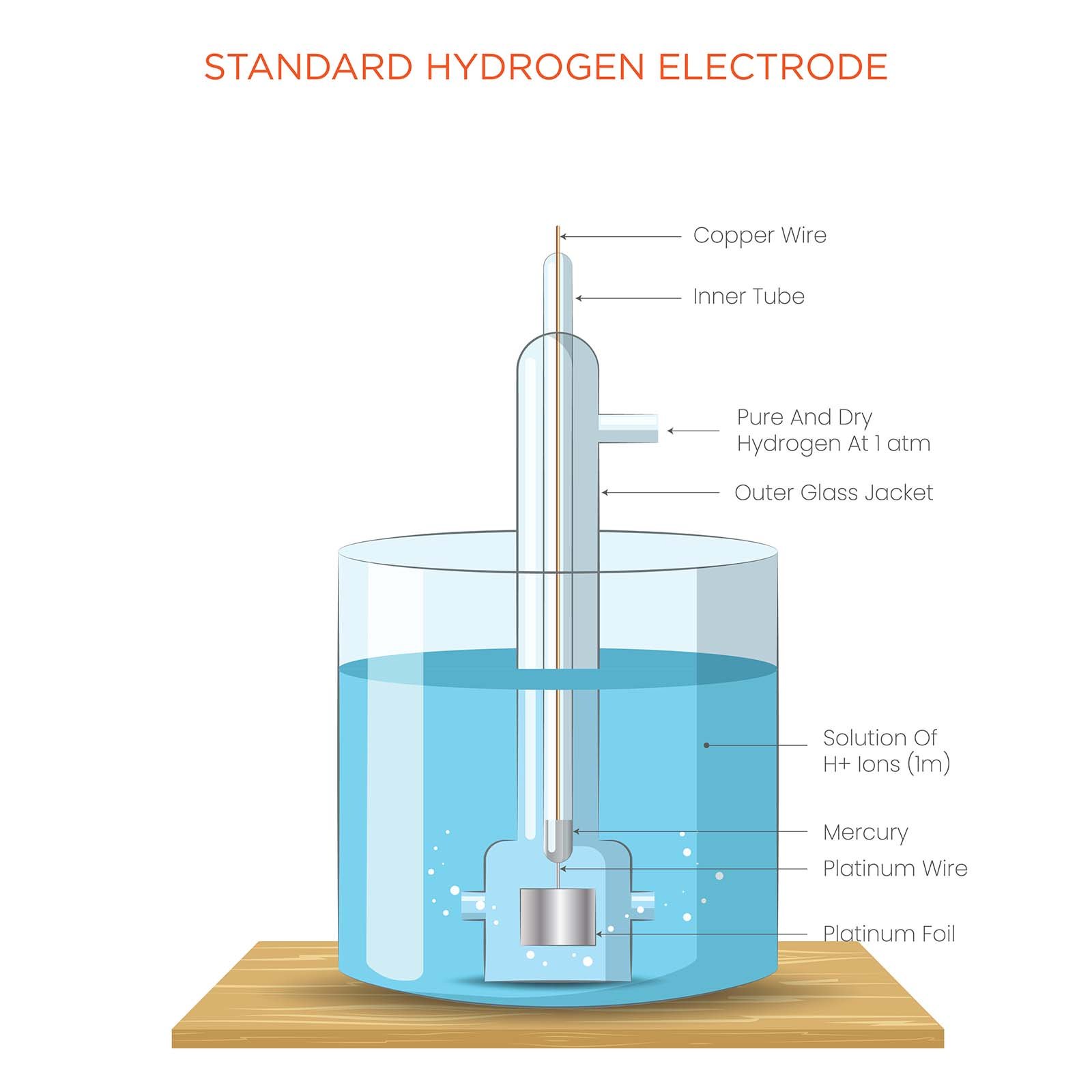
The Standard Hydrogen Electrode (SHE) serves as the universal anchor, assigned a value of 0 V based on the equilibrium of hydrogen gas oxidation and proton reduction. While the SHE is our theoretical gold standard, it is operationally cumbersome. Constant bubbling of hydrogen gas at 1 atm into a 1 M acidic solution is difficult to maintain outside of specialized calibration environments.
In the field, we favor more robust references like Silver/Silver Chloride (Ag/AgCl), Saturated Calomel (SCE), or Copper/Copper Sulfate (CSE). These electrodes provide stable potentials via standardized concentrations within their redox couples. However, using them requires diligence.
When combining electrochemistry with QCM-D, the choice of reference electrode becomes even more critical for a few reasons:
Contamination and Mass Shifts: A leaking reference electrode (e.g., leaking Cl- ions) can lead to unexpected mass changes on your quartz crystal. From personal experience, this can be a critical failure point: chloride ions can fundamentally alter metal plating behavior and morphology. Because EQCM-D is sensitive enough to detect nanogram-level mass changes and nano-scale roughness, this makes an impact.
Solvent Compatibility: If you are studying battery electrolytes, using an aqueous Ag/AgCl electrode can introduce water into your "water-sensitive" system, causing parasitic reactions that the EQCM-D will immediately detect as unexplained mass gain.
When contamination or solvent compatibility are concerns, it is possible to pivot to quasi-reference (QRE) or pseudo-reference electrodes. In contrast to traditional reference electrodes, these quasi- or pseudo-reference electrodes typically consist of a simple metal wire (like Platinum or Silver) immersed directly in the test solution. To improve stability, these wires can be coated. For example, a silver wire can be coated chemically or electrochemically with an AgCl or AgSO4 layer.1
A major advantage here is their small footprint. Traditional glass-bodied references can be bulky, whereas a wire electrode is significantly more compact. This plays to the advantage of EQCM-D cells, which typically have limited volumes.
Because these electrodes lack a self-contained, buffered environment, their potential is "pseudo" in nature, meaning it is sensitive to the local solution composition and prone to drift. To rectify this, an internal reference such as ferrocene can be added to the electrolyte. This provides a known redox potential that serves as a fixed anchor for the potential.1
Ultimately, the choice of reference electrode is not merely a technical detail, but a prerequisite for obtaining meaningful electrochemical insight. In EQCM-D experiments, where electrochemical processes are coupled to highly sensitive measurements of mass and interfacial change, even small instabilities in the reference point can influence how results are understood. Careful reference electrode selection is therefore essential for ensuring that the responses we observe reflect the intended chemistry of the system.
If you would like a broader introduction to the fundamentals of EQCM-D and electrochemical techniques, we invite you to watch our webinar Electrochemical QCM-D - a very short introduction


Viktor Vanoppen, M.Sc., is a guest writer for the blog. When he's not sharing his vast knowledge on electrochemistry and EQCM-D with the blog audience, he spends his time as a PhD candidate at Uppsala University, studying interfacial processes during metal plating for energy storage, combining EQCM-D, automation, machine learning, and advanced modeling techniques like Hydrodynamic Spectroscopy and FreqD-LBM