Thus far in this series, we explored techniques that apply a constant or sweeping signal, like the potential steps in chronoamperometry or the fixed currents in galvanostatic cycling. These direct current (DC) methods are excellent for observing how a system evolves over time or reacts to a specific driving force. But what if we want to learn more about the internal resistances and time-dependent behavior of the various components within an electrochemical cell? In this chapter, we step into the frequency domain to explore Electrochemical Impedance Spectroscopy (EIS).
EIS is a non-destructive technique that usually keeps the system close to a steady state (or open circuit potential, i.e., where no net redox reaction occurs). Instead of a constant signal, we apply a small alternating current (AC) or sinusoidal perturbation, typically an amplitude <10 mV, over a wide range of frequencies (in the mHz to 200 kHz range). This small perturbation is needed to enable an assumed linear relationship between the current and potential so that the system's response can be decomposed into frequencies and modeled as a linear circuit.
By measuring the system's current response and phase shift to this applied alternating voltage, we can determine the impedance - which you can think of as a resistance that depends on how fast you push (the frequency). Different processes that occur in electrochemical cells will respond differently depending on the frequency of the applied perturbation, allowing us to separate them, more or less.
To see why EIS is so powerful, we first need to understand the difference between resistance and impedance. In a simple DC circuit, resistance (R) is defined by Ohm’s Law (R=V/I). Simply put, resistance acts as a barrier to electron flow and, in the ideal case, does not depend on how fast you apply the voltage (the frequency).
However, electrochemical systems are complex. They contain interfaces that act like capacitors (double layers), diffusion processes that behave like time-dependent resistors, and charge transfer reactions. Impedance (Z) is the ratio between the AC voltage and the current, comparable to Ohm’s law but accounting for when our processes are sensitive to changes in frequency. The impedance is typically composed of a resistive (real part) and a capacitive part (imaginary part), Z = R + jX.
To understand EIS, it helps to think like an electrical engineer. Impedance spectroscopy is commonly used to characterize electrical circuits, and conveniently, an electrochemical cell can be represented as just that, a circuit composed of specific electrical components.
Consider two fundamental building blocks for electrochemical cells:
Real electrochemical systems are rarely just one or the other. They behave as complex combinations of these elements e.g., resistors and capacitors connected in series and parallel. The "spectrum" we record effectively maps how these different circuit elements dominate the response at different frequencies.
The data from an EIS experiment is often visualized in a Nyquist plot, where the negative imaginary impedance is plotted against the positive real impedance. The idealized cases from above, a pure resistor and pure capacitor, are shown in Fig.1, when plotted in Nyquist plots
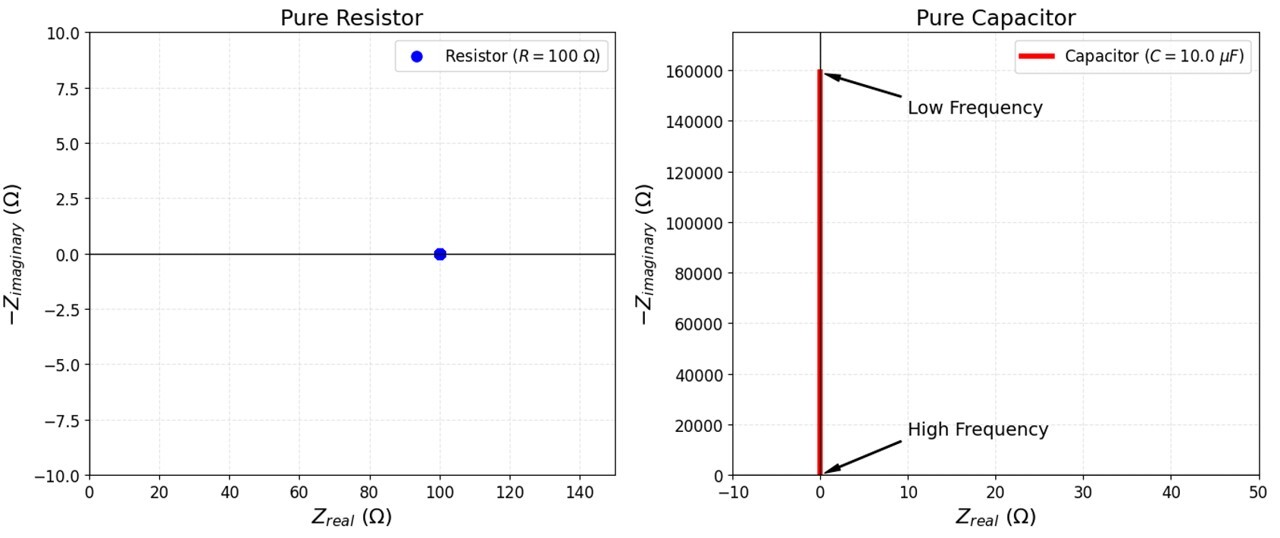
Figure 1. Impedance characteristics of fundamental circuit elements. (Left) Nyquist plot of a pure resistor (R=100 Ω), appearing as a frequency-independent point on the real axis. (Right) Nyquist plot of a pure capacitor (C=10 μF), displaying a vertical impedance response where frequency increases toward the origin.
When we perform an EIS measurement we typically sweep from high to low frequency, which usually maps the data from left to right on a Nyquist plot as the system's impedance increases for lower frequency processes. The Nyquist plot, Fig 2, exemplifies how different frequency ranges correspond to different physical processes:
By fitting this data to an equivalent electrical circuit (like the Randles circuit), we can isolate and quantify individual contributions, such as the resistance of the SEI layer in a battery or the polarization resistance in a corrosion cell. The Randles circuit and it’s corresponding ideal Nyquist plot are shown in Fig. 2.
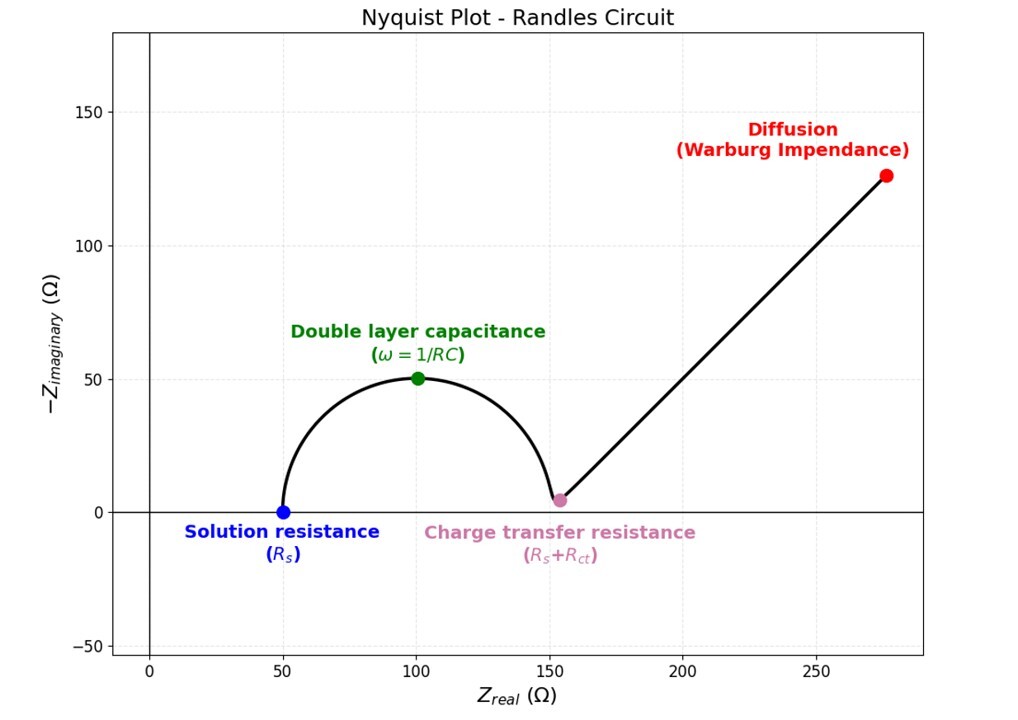
Figure 2: Nyquist plot of a representative Randles equivalent circuit. Solution Resistance (Rs): Determined by the high-frequency intercept on the real axis (blue point), representing the ohmic resistance of the electrolyte. Double-Layer Capacitance (Cdl): Extracted from the summit of the mid-frequency semicircle (green point), where the characteristic frequency obeys the relationship ω=1/RC. Charge Transfer Resistance (Rct): Calculated from the diameter of the semicircle; the second intercept on the real axis (pink point) indicates the total resistance Rs + Rct. Warburg Impedance (Zw): Observed as a 45° linear tail at low frequencies (red point), indicating mass-transport or diffusion-controlled processes.
One of the main challenges with EIS is that different physical systems can sometimes yield identical impedance spectra. Coupling EIS with EQCM-D reduces this ambiguity by providing physical observations of what is occurring at the interface.
By employing viscoelastic Voigt modeling, for instance, we can explore the link between electrical properties (measured by EIS) and mechanical properties (measured by EQCM-D) during interphase formation in batteries.
Here is how this combination clarifies the picture:
For readers interested in a deeper dive into the topic of combining EIS and EQCM-D, I highly recommend the manuscript by Kitz et al., which details the development and application of this methodology. [1]
EIS is a very versatile tool and finds many applications across different fields, below are two highlighted examples:
Corrosion: EIS allows researchers to measure corrosion rates in high‑resistance or poorly conductive, media where DC methods fail, such as monitoring the breakdown of passive films. It is also critical for evaluating protective layers, capable of detecting early damage long before visible failure occurs.[2] The ability of EQCM-D to track changes in the interphase further aids in developing and strengthening EIS models for corrosion.
Biosensors: In aptamer-based diagnostics (e.g., for prostate cancer), EIS tracks target binding through changes in charge transfer resistance. Simultaneous QCM-D measurements help researchers optimize the delicate balance between conformation and sensitivity of such sensors.[3]
Electrochemical Impedance Spectroscopy offers a way to "fingerprint" an electrochemical system, separating fast kinetic processes from slow transport phenomena. When used alone, it provides a breakdown of internal resistances. When paired with EQCM-D, it bridges the gap between the electrical model and the physical reality, offering a comprehensive picture of the interfacial dynamics.
Learn more about how these techniques are applied in real-world scenarios in the webinar Electrochemical QCM-D - a very short introduction, where we cover the basics of EIS and its combination with QCM-D.


Viktor Vanoppen, M.Sc., is a guest writer for the blog. When he's not sharing his vast knowledge on electrochemistry and EQCM-D with the blog audience, he spends his time as a PhD candidate at Uppsala University, studying interfacial processes during metal plating for energy storage, combining EQCM-D, automation, machine learning, and advanced modeling techniques like Hydrodynamic Spectroscopy and FreqD-LBM