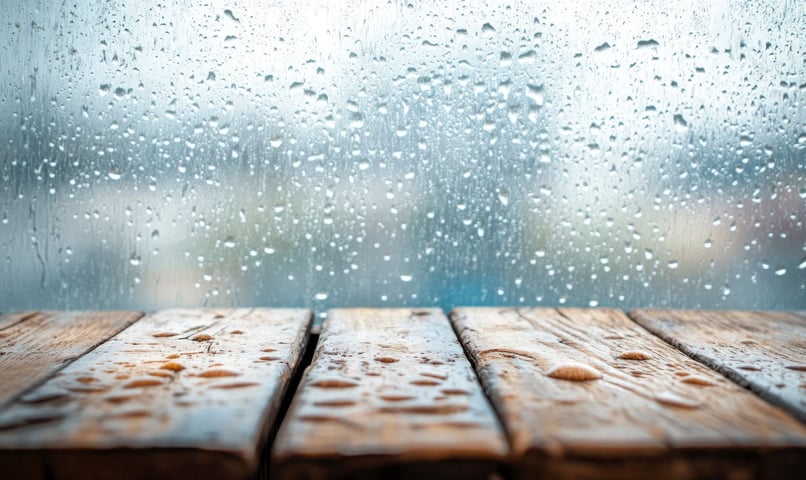
Water droplets are everywhere—on leaves after rain, on your window in the morning, or even on the surface of a freshly washed car. But have you ever wondered why water forms droplets at all, and why those droplets take on their characteristic shapes? Understanding the science behind water droplets not only satisfies curiosity but also has practical implications in fields ranging from biology to materials science.
At the heart of droplet formation are two key molecular forces: cohesion and adhesion.
Surface tension is a direct result of cohesion. Water molecules at the surface experience a net inward force, pulling them closer together and minimizing the surface area. This is why water, when unconstrained, tends to form a sphere—the shape with the smallest possible surface area for a given volume.
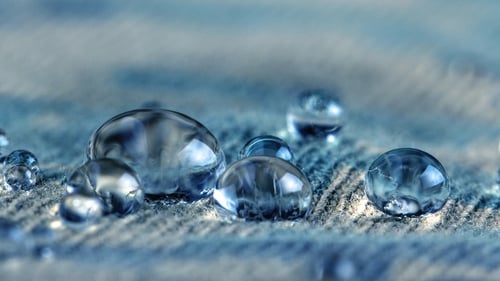
In the absence of other forces, such as gravity or contact with a surface, a water droplet in air will naturally form a nearly perfect sphere. This spherical shape is the result of surface tension pulling the molecules into the tightest possible configuration. For very small droplets, gravity has little effect, so the droplet remains almost perfectly round. For larger droplets, gravity causes slight flattening at the bottom.
When a water droplet lands on a surface, its shape is determined by the balance between cohesive forces (within the droplet) and adhesive forces (between the droplet and the surface).
On a surface, the contact angle is formed at the edge where the water, air, and solid surface meet. It’s a key indicator of how a droplet interacts with a surface:

Nature: Dew drops on grass, rain on leaves, or water on spider webs.
Technology: Water-repellent coatings for textiles and glass, inkjet printing, and microfluidics.
Science: Measuring contact angles helps researchers understand surface properties and develop new materials.
Water droplets are a beautiful and fascinating example of physics in action. Their shape—whether floating in air or resting on a surface—tells a story about the invisible forces at play. Next time you see a droplet, take a closer look and appreciate the science behind its simple elegance.

Susanna is an Application Scientist at Biolin Scientific. In her PhD thesis, she developed fabrication methods for a new type of inorganic-organic polymers. Microfabricated polymer chips were utilized as tool for biomolecule separation in analytical chemistry.