Smart materials are materials that sense a change in their environment and respond in a useful, reversible way. In other words, a smart material doesn’t just passively sit there – it actively changes one of its properties, such as shape, color, stiffness, or wettability, when it is exposed to a specific stimulus.
In this article, we will look at what smart materials are, how they work, and why many of the most interesting “smart” behaviors are actually happening at the surface. We will focus on one key surface property – wettability – and show how controlled changes in contact angle allow smart surfaces and coatings to move droplets, resist fouling, or become self‑cleaning.
What is a smart material?
A smart material is a material whose properties (such as shape, stiffness, color, electrical conductivity, or wettability) change in a controlled and repeatable manner when exposed to an external stimulus like temperature, electric or magnetic field, stress, light, pH, or the presence of a particular liquid.
Two features are key:
- Stimulus‑responsive: The material responds to a specific trigger.
- Reversible (or at least repeatable): When the stimulus is removed or changed back, the material’s property also returns, fully or partially, to its original state.
This makes smart materials very different from traditional materials, which typically have fixed properties unless they degrade or are damaged.
Some classic examples of smart materials are shape memory alloys, piezoelectric materials, and thermochromic and photochromic materials. Many of the most exciting current developments, however, do not primarily rely on changes in the bulk of the material, but on its surface. That is where wettability comes into play.
From smart materials to smart surfaces
In many real applications, liquids, cells, or proteins only interact with the outermost layer of a material. A medical implant, for instance, may be made of titanium, but what a cell “sees” is the surface chemistry and topography of the outer few nanometers.
This is why it is often more accurate to think about smart surfaces rather than just smart materials:
- A smart surface is a surface whose properties (such as wettability, adhesion, friction, or charge) change in response to an external stimulus.
- The bulk material underneath can even remain unchanged; all the “smart” behavior can be engineered into a thin coating, a polymer brush, or a nano‑structured surface.
Among these surface properties, wettability – how a liquid spreads or beads up on a surface – is one of the most critical, especially for coatings, microfluidics, self‑cleaning materials, and biomedical interfaces.
Why wettability is a key property of smart surfaces
Wettability describes how easy or difficult it is for a liquid to spread over a solid surface.
You see it every day:
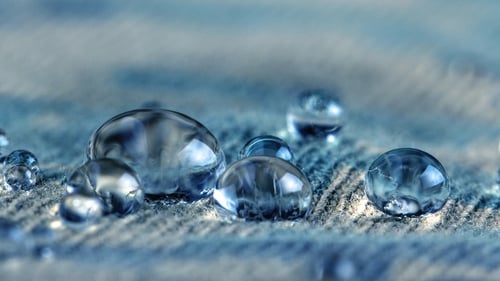
- Water beading up on a freshly waxed car hood (low wettability, hydrophobic surface).
- Water spreading out on clean glass (high wettability, hydrophilic surface).
Wettability is typically quantified by the contact angle: the angle between the solid surface and the tangent to the liquid droplet at the point of contact.
- High contact angle (e.g. > 90° for water) → low wettability → hydrophobic surface.
- Low contact angle (e.g. < 90° for water) → high wettability → hydrophilic surface.
For smart surfaces, the “smart” behavior is often a controlled, reversible change in contact angle with a stimulus. That is, the material can switch between more hydrophilic and more hydrophobic states, depending on conditions.
This switchable wettability underlies many practical functions:
- Moving, splitting, or merging droplets on a device.
- Triggering self‑cleaning or de‑icing properties.
- Controlling protein adsorption or cell adhesion.
- Tuning how oils and water separate in filters or membranes.
Examples of smart materials with switchable wettability
Many classes of smart materials can be designed specifically to show responsive wettability. Below are some widely studied examples.
Temperature‑responsive polymer coatings
Certain thermo‑responsive polymers change their affinity to water at a specific temperature, known as the lower critical solution temperature (LCST).
A common example is a polymer that is:
- Hydrophilic below the LCST → water wets the surface well, contact angle is relatively low.
- More hydrophobic above the LCST → water beads up more, contact angle increases.
When grafted as a thin coating or polymer brush on a surface:
- Heating the system above the LCST can cause the polymer chains to collapse, expelling water and making the surface appear more hydrophobic.
- Cooling back below the LCST can re‑hydrate and swell the chains, making the surface more hydrophilic again.
From a measurement perspective, you can track the contact angle as a function of temperature to quantify how “smart” the coating is.
Light‑responsive surfaces
Some smart coatings include photo‑switchable molecules, such as azobenzene derivatives, which change conformation under UV or visible light.
- One conformation can expose more hydrophilic groups toward the surface.
- The other conformation can expose more hydrophobic groups.
By shining light of different wavelengths, you can toggle the surface wettability:
- UV light might make the surface more hydrophilic (lower contact angle).
- Visible light might return it to a more hydrophobic state (higher contact angle).
This principle is highly attractive in microfluidics and lab‑on‑a‑chip, where light can remotely control how droplets move and interact without any mechanical valves.
Electric‑field‑controlled wettability (electrowetting)
In electrowetting, an applied voltage changes the effective contact angle of a liquid droplet on a surface.
The underlying surface is often coated with a hydrophobic dielectric layer. Without voltage, the droplet forms a relatively high contact angle. When a voltage is applied between the droplet and an electrode beneath the dielectric:
- The apparent contact angle decreases with voltage.
- The droplet spreads out and can move across patterned electrodes.
Electrowetting enables:
- Digital microfluidics: manipulating individual droplets for mixing, splitting, and transport.
- Adaptive lenses and displays: changing the shape of a liquid interface to focus light or modulate optical properties.
Here, the smart behavior is literally electrically tunable wettability.
Measuring wettability: How we know a surface is “smart”
To understand and optimize a smart surface, we need to measure how its wettability changes under different stimuli. This is where contact angle and related surface characterization become essential.
Key concepts include:
- Static contact angle
The angle measured when a droplet is at rest on the surface. Good for a quick snapshot of wettability.
- Dynamic contact angles (advancing and receding)
Measured while the droplet volume is increased (advancing angle) or decreased (receding angle). These angles reveal hysteresis, surface heterogeneity, and pinning effects, all important for realistic applications like self‑cleaning or droplet transport.
- Surface free energy
Estimated by measuring contact angles with multiple liquids and applying suitable models. This gives insight into the polar and dispersive components of the surface, which helps understand interactions with different fluids.
To characterize a smart surface:
- Baseline measurement
Measure contact angle (static or dynamic) under reference conditions (e.g., room temperature, no applied field).
- Apply stimulus
Change temperature, pH, voltage, light, or another relevant parameter.
- Measure again
Record how the contact angle and droplet behavior change.
- Cycle and repeat
Test reversibility and durability by cycling the stimulus multiple times and tracking whether the wettability response remains stable.
These measurements allow researchers to:
- Quantify how large the change in wettability is (e.g. shift from 70° to 110°).
- Determine how fast the response is.
- Evaluate how many cycles the material can sustain without losing its smart behavior.
At Biolin Scientific, a core focus is to help researchers and engineers quantify these surface and interfacial phenomena. Instruments for contact angle and wettability, in combination with other techniques for surface characterization, make it possible to design and validate smart materials and coatings with confidence.
Frequently asked questions
Is every smart material also a smart surface?
Not necessarily. Some smart materials show bulk changes (like shape memory alloys). However, many modern applications focus on thin films and coatings, where what truly matters is the surface response – for example, a change in wettability.
Is a superhydrophobic surface always a smart material?
A superhydrophobic surface has extreme water repellency (very high contact angle), but it is not automatically “smart.” To be considered smart, the surface should change its wettability (or another property) in a controlled way when stimulated.
Can wettability be changed reversibly many times?
In well‑designed systems, yes. Polymers and coatings can be cycled repeatedly between hydrophilic and hydrophobic states. However, real‑world durability depends on factors like chemical stability, mechanical wear, UV exposure, and contamination.
How do you measure changes in wettability in the lab?
Typically by performing contact angle measurements under controlled conditions while varying the stimulus (temperature, light, voltage, etc.). Repeating measurements over time and cycles gives information about the magnitude, speed, and stability of the response.
Summary: From smart materials to smart wettability control
Smart materials are defined by their ability to sense and respond to their environment in a reversible, useful way. When this intelligence is engineered into the surface, the most visible effect is often a controlled change in wettability, measurable through changes in contact angle.
By designing surfaces whose wettability responds to temperature, light, electric fields, or chemical environment, researchers can create self‑cleaning coatings, programmable microfluidic devices, advanced biomedical interfaces, and adaptive separation membranes.
Understanding and quantifying these changes in wettability is essential for turning laboratory concepts into robust applications. That is why accurate, reliable surface and interfacial measurements play such a central role in the development of smart materials and smart surfaces.
If you would like to learn more about contact angle measurement techniques, please download the white paper below.