Wettability is the tendency of a liquid to spread on and adhere to a solid surface. It is important in enhanced oil recovery (EOR) because it controls how oil and water distribute in the reservoir rock and how easily oil can be displaced and produced.
Wettability determines the interactions between the solid rock and the reservoir fluids (crude oil and brine), and it has been recognized as one of the key parameters controlling the remaining oil‑in‑place and the efficiency of many EOR methods.
Reservoir rocks can be classified as water-wet, mixed-wet or oil-wet.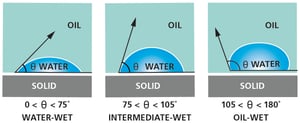 When the rock is water-wet, water is preferentially in contact with the mineral surface when oil is the surrounding phase. In an oil‑wet rock, oil preferentially coats the rock and water is pushed away from the surface. The state in between is called intermediate- or mixed-wet.
Wettability is commonly quantified using contact angle measurements, which give the angle between the solid surface and a liquid droplet at the three‑phase contact line. Different contact angle ranges correspond to different wetting states, from strongly water‑wet to strongly oil‑wet.
Carbonate reservoirs are typically mixed‑wet or oil‑wet, which means that oil tends to adhere strongly on the carbonate surface. This inhibits oil production when non‑wetting phase injections such as water flooding are used, because the injected water cannot easily displace the oil from the rock surface.
As a result, large amounts of oil can remain in the reservoir even after primary and secondary recovery, and the recovery factors are often lower for carbonate than for sandstone reservoirs. To increase the recovery ratio from carbonate reservoirs, enhanced oil recovery methods are needed, and wettability alteration has been proposed as one of the main mechanisms for enhanced oil recovery.
Wettability alteration is an effective approach to enhanced oil recovery. The purpose of wettability alteration is to change the wetting state of the rock toward a more water‑wet condition. Several factors, including crude oil composition, brine chemistry, rock surface morphology, as well as temperature, pressure and saturation history, affect the wettability of the rock–oil–brine system.
Different approaches have been developed to adjust the wettability of reservoirs. For a carbonate reservoir that is oil‑wet, the main methods include CO₂ injections and chemical flooding with polymers. Alternative methods are constantly being developed due to the increasing importance of carbonate reservoirs as our source of oil in the future.
Wettability describes whether the rock surface prefers to be in contact with water or oil when both fluids are present. In a water‑wet reservoir, water coats the rock surface and oil occupies the centers of the pores, while in an oil‑wet reservoir the opposite is true. This preference strongly affects how easily injected fluids can displace oil.
Reservoir wettability is commonly evaluated using contact angle and interfacial tension measurements. Using high pressure optical tensiometers, these measurements can be performed at elevated temperatures and pressures to mimic real reservoir conditions.
Carbonate reservoirs are often characterized as mixed‑wet or oil‑wet due to their mineralogy, surface chemistry and the interaction history with crude oil and formation brine. This leads to a tendency of the oil to adhere strongly to the carbonate surface, which in turn makes it difficult for conventional water flooding to displace the oil efficiently.
Wettability can be altered by changing the composition of the injected fluids or the conditions in the reservoir. Examples include gas injection (such as CO₂‑EOR), chemical methods with polymers and surfactants, and thermal methods that increase temperature. These approaches can shift the rock toward a more water‑wet state and, together with interfacial tension reduction, help mobilize additional oil.
If you want to dive deeper into how wettability is actually measured in the lab for EOR projects, you are welcome to join our webinar “Measuring wettability and interfacial tension for EOR optimization”.
In this 60‑minute session on May 12, 2026, Susanna Laurén from Biolin Scientific walks through how contact angle and interfacial tension measurements are used to characterize fluid–rock interactions and to support EOR decision‑making. You will get an overview of the main measurement techniques, practical tips for reliable data, and examples of how lab results translate into better EOR design.


Susanna is an Application Scientist at Biolin Scientific. In her PhD thesis, she developed fabrication methods for a new type of inorganic-organic polymers. Microfabricated polymer chips were utilized as tool for biomolecule separation in analytical chemistry.