PFAS (per- and polyfluoroalkyl substances) have set the standard for water, oil, and stain repellency in coatings for decades, thanks to their unique chemical properties and durability. However, increasing awareness of their environmental persistence and potential health risks has prompted regulatory action and a global movement toward safer, more sustainable alternatives. This article explores the role of PFAS in coatings, the challenges of replacing them, and the innovative strategies driving the development of high-performance PFAS-free coatings.
Why are PFAS used in coatings?
PFAS are synthetic chemicals known for their strong carbon-fluorine bonds, which deliver:
- Exceptionally low surface energy for water, oil, and stain repellency,
- High durability and resistance to abrasion, UV, and chemicals, and
- Long-lasting performance in challenging environments.
These properties have made PFAS-based coatings common in textiles, food packaging, automotive finishes, architectural surfaces, and electronics.
Why are PFAS-free coatings needed?
The move toward PFAS-free coatings is driven by a combination of regulatory changes, scientific findings, and shifting market expectations. As more is understood about the persistence of PFAS in the environment, concerns have grown about their ability to accumulate in living organisms and their potential health effects. In response, authorities in Europe and elsewhere are introducing stricter regulations that limit or ban the use of PFAS in many products.
At the same time, many manufacturers and end-users are looking for solutions that align with sustainability goals and consumer preferences for safer materials. These factors are accelerating the search for alternatives that can match the performance of PFAS-based coatings without the same environmental or health risks.
However, meeting these new requirements is not straightforward. The transition to PFAS-free coatings brings a unique set of technical and practical challenges that must be addressed for successful adoption.
Challenges in developing PFAS-free and non-fluorinated coatings
Developing PFAS-free and non-fluorinated coatings presents several significant challenges. One of the foremost difficulties is replicating the exceptional water, oil, and stain repellency provided by PFAS, as few alternative chemistries achieve similarly low surface energy or high contact angles. In addition, ensuring long-term durability—including resistance to abrasion, ultraviolet (UV) exposure, and harsh chemicals—remains a critical requirement for many applications.
Material and process compatibility is another key consideration. New coating formulations must integrate seamlessly with existing substrates and manufacturing processes, which can be complex when introducing novel materials or techniques. Additionally, cost and scalability are important factors; sustainable coatings must be economically viable for large-scale production and use.
Key strategies for developing PFAS-free coatings
To address the technical and regulatory challenges associated with replacing PFAS in coatings, researchers and manufacturers are employing a variety of innovative approaches. The development of effective PFAS-free coatings requires a combination of new materials, advanced surface engineering, and careful formulation. Below are some of the primary strategies being explored to achieve high performance and sustainability in non-fluorinated coatings:
-
Alternative Chemistries:
Hydrocarbon, silicone, and bio-based polymers are being optimized to provide water and oil repellency, durability, and environmental compatibility. Hybrid systems and nanocomposites, which combine polymers or incorporate nanoparticles, can further enhance barrier properties and mechanical strength.
-
Surface Engineering:
Techniques like nanostructuring and plasma or layer-by-layer treatments modify surface texture and surface energy, amplifying repellency and improving adhesion without the need for fluorinated compounds.
-
Functional Additives:
Non-fluorinated surfactants, crosslinkers, and hardeners are used to improve wetting, film formation, and resistance to abrasion or chemicals, helping PFAS-free coatings approach the performance of traditional systems.
-
Formulation and Process Optimization:
Careful selection and balance of binders, pigments, and fillers, as well as adapting application methods, are essential for achieving uniform, high-performing coatings that meet industry standards.
How are PFAS-free coatings tested and characterized?
Thorough testing is essential to ensure that PFAS-free coatings deliver the performance required for demanding applications. Modern optical tensiometers, such as Biolin Scientific’s Theta Flow, Theta Flex and Theta Lite as well as Sigma force tensiometers, offer a comprehensive suite of surface and interfacial measurements that help researchers and manufacturers test and develop new coating formulations. Key measurements include:
Static water and oil contact angle
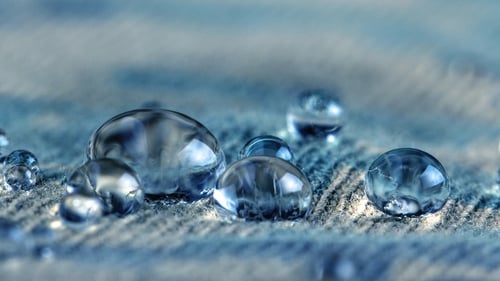
Measuring the static contact angle of water or oil droplets on a coated surface provides a straightforward assessment of repellency. High contact angles indicate that liquids bead up and are less likely to wet or stain the surface, which is a requirement of effective hydrophobic or oleophobic coatings.
Dynamic contact angle
Dynamic contact angle testing goes beyond static values to reveal how a droplet behaves as it moves across the surface. By measuring advancing and receding angles, as well as contact angle hysteresis, it is possible to assess how easily droplets roll off or stick to a coating. The roll-off (or sliding) angle, which is the minimum tilt angle at which a droplet begins to move, is particularly important for evaluating self-cleaning and anti-fouling properties.
Dynamic contact angle measurements are especially valuable for distinguishing between coatings that may have similar static contact angles but perform differently in real-world use. For example, a coating with a low roll-off angle and low contact angle hysteresis will shed water more easily, leading to improved cleanability and resistance to dirt accumulation. These insights are critical for applications, where easy cleaning and long-term durability are desired.
To learn more about using dynamic contact angle measurements to characterize water repellency of coatings, please watch our webinar through the link further below.
Surface free energy and surface tension
Determining the surface free energy of solids and the surface tension of liquids is fundamental for understanding wetting, adhesion, and the uniformity of coatings. These measurements help guide the selection of materials and optimize formulations for improved spreading, adhesion, and durability.
Conclusion
The transition to PFAS-free coatings is both necessary and complex. As regulations tighten and sustainability goals become more central, the coatings industry must balance performance demands with environmental and health considerations. Although challenges remain in replicating the unique properties of PFAS, ongoing advances in materials, formulation, and testing are paving the way for safer and more effective alternatives. Comprehensive surface and interface testing will play a crucial role in developing and validating high-performance PFAS-free coatings.







.jpg?width=160&name=anna%20junnila%20(resized-1).jpg)