Paper, paperboard and fiber‑based packaging are used in many forms and applications. Whenever inks, coatings, adhesives or seal layers are involved, the way liquids interact with the surface becomes critical for print quality, barrier performance and bonding.
Whether the substrate is a graphical paper, a folding carton board, or a board used in food and liquid packaging, the same question keeps coming up: how will liquids wet, spread and adhere on this surface?
To answer this, we look in this article at the key surface properties for paper and board – wettability and contact angle, surface free energy, and surface roughness – and how to measure them and link the results to product performance.
Paper & paperboard surface properties - what are we talking about?
The surface of a paper or board is shaped by its surface chemistry, the underlying fiber and coating structure, and the process history (refining, forming, drying, calendering, surface treatments). When we characterize the surface, this shows up in a small set of measurable properties:
-
Wettability and contact angle – how droplets behave when they meet the surface
-
Surface free energy – how “attractive” the surface is to different liquids
-
Surface roughness and topography – how smooth or structured the surface is at the micro‑scale
Let's take a closer look at these properties one by one.
Wettability and contact angle on paper and board
Wettability describes how a liquid interacts with a surface. On a highly wettable surface, the liquid spreads out on the surface. On a low‑wettability surface, the liquid forms droplets and does not spread easily on the surface. Contact angle, the angle formed between a drop tangent and the surface, gives a quantitative measure of this:
Contact angle measurements on are widely used to:
-
Compare how different coatings, sizing levels or treatments change the surface of the same base material
-
Check that surface treatments, such as corona or plasma treatment, are within their specification window
-
Get an initial indication of how water‑based inks, varnishes or adhesives will behave on a new substrate
On paper and board, it is often useful to follow the contact angle over time, because penetration into the sheet can change how the droplet behaves after the first contact.1
Surface free energy of paper and board
A basic requirement for a liquid to wet a surface is that the surface free energy of the solid needs to be higher than surface tension of the liquid.
While a single contact angle value describes how one liquid behaves on a surface, surface free energy is a property of the solid that can be used to tell how any liquid behaves on that solid. By measuring contact angles with several probe liquids, it is possible to estimate the total surface free energy of the solid and its dispersive and polar components.
Surface free energy is useful when you want to:
-
Evaluate whether a new ink, varnish or adhesive will wet and adhere to a particular substrate
-
Decide if a primer or additional surface treatment is required
-
Compare how different coating formulations modify the surface of the same base material
For packaging, lamination and sealing, surface free energy is one of the central parameters used when substrates and liquids are designed to work together.
Surface roughness and topography of paper and board
Research on cellulosic materials underlines that paper and board are rough, porous and water‑swellable, rather than ideal flat solids. Even when a paper or paperboard appears smooth to the eye, the micro‑scale surface consists of:
-
Raised areas formed by fibers, fines, fillers and coating pigments
-
Valleys and pores between them
-
Local features created by forming, drying and calendering
Because of this structure, roughness can increase the true liquid–solid contact area and reinforce wetting, or reduce the effective contact area if air is trapped under the droplet, making the surface appear more water‑repellent. On paper‑based materials, both behaviors are possible and depend on the combination of substrate, liquid and process history.
In practice, this means that:
-
The same coating formulation can show different behavior on a smoother versus a rougher base material
-
Two trials can give similar contact angle values but still differ in visual appearance and functional performance
Because of these reasons, it is often recommended to consider surface roughness and contact angle together, especially when the substrate or process conditions change significantly.1
When paper & board surface properties are especially important
Surface properties of paper and paperboard are always important, but they tend to become particularly visible when there are changes in the used materials or performance targets. Today, many materials are being redesigned, with more recycled content, lower basis weights and new barrier and coating chemistries such as PFAS‑free and bio‑based systems.
Increasing recycled content
Moving towards higher recycled fiber content supports sustainability objectives but typically changes the following properties of paper and board:
-
Fiber quality and fines content
-
Surface roughness and pore structure
-
The response of the surface to calendering and coating
These changes can influence both initial wetting of the surface and how quickly liquids penetrate into the sheet. Keeping track of surface behavior helps avoid unexpected shifts in appearance, coating performance or bonding when the fiber mix or fiber sources are adjusted.2
Lightweighting
Reducing basis weight is an effective way to save fiber and transport costs. At the same time, the sheet can become more sensitive to variations in coating load and surface treatment. In addition, there is less flexibility to use calendering to smooth the surface without reducing stiffness and thickness of the board. Surface measurements provide guidance on how far the material can be light‑weighted while maintaining target print, coating and converting performance.
New barrier and coating systems
New PFAS‑free, bio‑based and other advanced coating systems rely strongly on controlled surface interactions. Their performance depends on how they wet, spread, solidify and remain stable on the substrate.2
Understanding surface properties of the base material makes it easier to figure out if you should:
-
Modify the coating formulation,
-
Adjust or pre‑treat the substrate, or
-
Change process conditions such as drying and calendering.
Measurement toolbox for paper & board surface design
A small, well‑chosen set of measurements already provides a strong basis for surface design and troubleshooting. Typical tools include measurements done with optical tensiometers:
Contact angle measurements
These reveal how liquids initially interact with the surface and how stable that interaction is over time.
Surface free energy measurements
By measuring contact angle on the surface with several probe liquids, you can estimate the surface free energy and its components. This indicates how easily different liquids will wet and adhere to a specific surface, and helps you understand where to adjust the liquid formulation or the surface treatment.
Related reading: Surface free energy measurements in practice
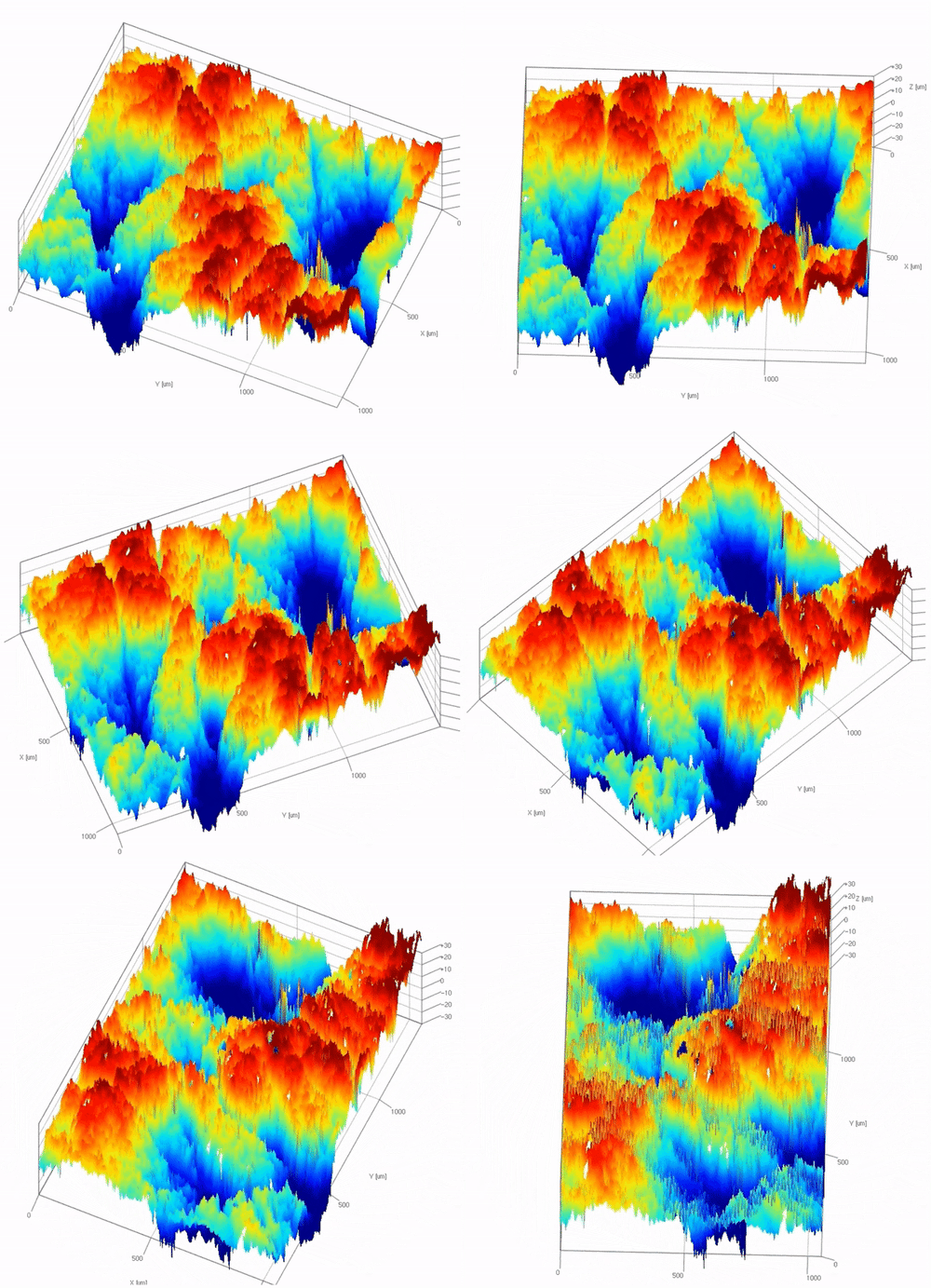
3D topography and surface roughness
3D topography measurements provide a quantitative description of how smooth or structured the surface is. For paper and board, this is particularly important because the roughness features are often on the same length scale as the droplet footprint and strongly influence the apparent contact angle. 1
When data on surface roughness is combined with contact angles measured on the same location, it becomes possible to separate:
and when needed, to use roughness‑corrected contact angles to approximate the intrinsic wetting of the surface. This combined approach is valuable for fiber‑based materials, where both chemistry and structure change when for example recycled content, basis weight or calendering are adjusted. 1
For this type of work, it is very helpful to use an optical tensiometer that can combine 3D topography and contact angle measurements on the same spot. Biolin Scientific currently offers a unique implementation of this approach, with a 3D topography module integrated in the optical tensiometer, so that surface roughness and contact angle can be measured together in routine lab use.
Surface and interfacial tension of liquids
Measuring the surface and interfacial tension of inks, coatings and adhesives gives information about how they will behave on a given substrate and whether adjustments are needed on the liquid side to achieve desired wetting and spreading.
Linking measurements to performance
The most important step is to relate these measurements to what happens in practice:
-
Print tests and visual evaluation
-
Barrier and migration tests
-
Converting, forming and end‑use performance
Over time, this creates a surface profile for successful materials – a range of contact angles, surface energies and roughness characteristics that are known to give reliable results.1
FAQ - surface properties of paper and board
When is contact angle enough, and when do I need roughness‑corrected values?
Contact angle is a very informative starting point, especially when the base material and process stay stable. For routine monitoring on the same substrate, apparent contact angles are often sufficient to follow trends. Once you begin changing fiber mix, basis weight, coatings or treatments, roughness and porosity will also change. In those cases, using roughness‑corrected contact angles makes it easier to see whether a difference is mainly due to chemistry or to surface structure.
How many measurement points should I take on a sheet?
Paper and board are not fully uniform across the surface. Relying on a single point can therefore be misleading. It is often better to measure at several positions and consider both the average and the spread of the values.
Are these surface properties only important for food packaging?
Food packaging is an area where surface properties have been studied in detail because they affect barrier performance, product safety and shelf life. However, the same principles apply to graphical papers, folding cartons, specialty boards and many other paper‑based products.
Summary
Designing paper and board surface properties is about making the surface behave in a controlled and predictable way. Research on cellulosic surfaces and packaging materials emphasizes that understanding wettability and related properties requires considering chemistry and structure together.
With a small, consistent set of surface measurements in place, adapting or developing materials becomes less about trial and error and more about guided decisions – supported by data that connects the lab to real performance.
If you would like to learn more about how surface roughness affects wettability and how it can be measured together with contact angle, please download our white paper below.







.jpg?width=160&name=anna%20junnila%20(resized-1).jpg)