How Much Does a Force Tensiometer Cost?
Anna Junnila Aug 18, ’26 > 6 min

How Much Does a Force Tensiometer Cost?

Force tensiometers typically range from $5,000 for entry-level, manual instruments to $50,000 or more for fully automated systems equipped with dispensers, temperature control, and other accessories.

The purchase price only tells part of the story. This post covers what drives that range, and how training time, software, and maintenance costs shape what a force tensiometer actually costs to own over time.

What affects the price of a force tensiometer?

A few factors account for most of the differences between force tensiometer prices:

  • Automation.

    Manual sample stage positioning and single-point measurements cost less than systems that automate measurement workflows, data handling, and result reporting. 
  • Precision and sensitivity. 
    Instruments built for high-sensitivity measurements are typically priced higher than general-purpose models.
  • Software.
    Licensing model, upgrade costs, and whether measurement modules are bundled or sold separately all affect price heavily − both at purchase and over time.
  • Accessories.
    Temperature control units, additional measurement probes and other add-ons are often priced separately.

What the price tag doesn't show

Two labs can buy a force tensiometer at the same price and end up with very different costs over its lifetime. A few things drive that gap:
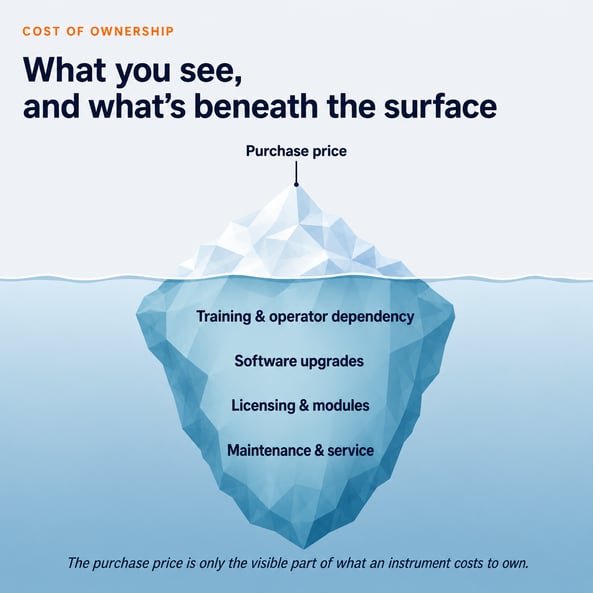
  • Training and operator dependency.
    Software and workflow design can still differ widely between similarly automated instruments. A less intuitive interface means longer training time for new users and more room for operator-to-operator variation in results — a cost that doesn't show up on the price tag.
  • Software upgrades.
    Free upgrades keep the software cost fixed at the point of purchase, while paid upgrade models mean the real cost is spread out — and can add up — over the years you own the instrument. 
  • Licensing and modules. 
    Some suppliers charge extra to license the software on additional computers, or to add software measurement modules not included in the original purchase. Others provide unlimited licensing and include all measurement modes from the outset, so expanding needs don't come with added cost. 
  • Maintenance and service. 
    Service contract costs and day-to-day upkeep requirements vary between instruments and are easy to underestimate when comparing purchase prices alone. Response times matter too — how quickly a supplier can get an instrument running again after a problem can be as costly as the maintenance itself, especially for labs running continuous testing.

image of factors that affect the total cost of ownership for force tensiometer

Where automation pays for itself

Automation adds to the upfront price, but it can lower the total cost of ownership in ways that do not show up on a spec sheet. Automated dosing and data handling reduce the time you need to spend actively running a measurement.

Some instruments also let you save measurement recipes or use guided workflows that walk you through the measurement steps. In some cases, these workflows are designed around specific industry standards, helping you follow the required procedure and perform the measurement in line with the standard.

Repeatable workflows can reduce differences in results between operators. This matters most if your lab runs high volumes of samples or relies on multiple staff members to get consistent data. Whether that trade-off is worth it depends on how often you use the instrument and how many people will be running it.

How to weigh it for your lab

There's no single "right" price point — the better question is whether an instrument's cost matches how it will actually be used. A few practical questions can help: 

  • How often will the instrument run, and how many people will operate it? 
    Higher usage and more operators make automation and consistency worth more.
  • How much time can you dedicate to training? 
    Manual instruments take longer to train new users on, which adds an ongoing cost that's easy to overlook.
  • What's your budget over the instrument's lifetime, not just at purchase? 
    Software upgrade fees and service contracts should factor into the comparison, not just the purchase price.
  • Do you need all available measurements now, or might you need more later?
    Instruments that require separate software modules for added capabilities can end up costing more over time than an all-inclusive system.

Working through these questions before comparing instruments can help you look past the purchase price and focus on what actually fits your lab. 

Ready to compare instruments?

For closer look at the features and capabilities behind these cost differences, see our article on How to Choose a Force Tensiometer.

If you're ready to start comparing specific instruments, our free 2-page question guide covers the right questions to ask yourself and your suppliers. You can download it below. 

Biolin Scientific
Guide

Buying a Force Tensiometer: Key Questions

Download guide

FAQ

How much does a force tensiometer cost?

Prices typically range from $5,000 for entry-level, manual instruments to $50,000 or more for fully automated systems with dispensers, temperature control, and other accessories. The right price point depends on how the instrument will be used, not just its features on paper.

Is a cheaper force tensiometer less accurate?

Not necessarily. Entry-level instruments can produce accurate results within their intended measurement range. The difference is usually in consistency: manual instruments rely more on the operator's technique, while automated instruments reduce that variability.

What is not included in the purchase price?

Training, installation, and maintenance are often priced separately. Accessories such as automated dispensers, temperature control units, and different measurement probes typically add to the base price as well.

Do force tensiometers come with ongoing software costs?

This varies by supplier. Some include free software upgrades for the life of the instrument, while others charge for each new version. It is worth asking suppliers directly about their upgrade policy before purchasing.

Is paying for automation worth it for a small lab?

It depends on how often the instrument will be used and by how many people. Labs with high sample volumes or multiple operators tend to see automation pay for itself through saved time and more consistent results. For occasional use by a single trained operator, a manual or semi-automated instrument may be enough.

Related products

Explore the blog

You have only scratched the surface.

Popular

Archive

View all

Explore new era of force tensiometers