Critical micelle concentration (CMC) is one of the most important parameters when working with surfactants. It tells you the concentration at which surfactant molecules stop accumulating at interfaces and start forming micelles in bulk solution. Knowing the CMC is crucial for formulating detergents, pharmaceuticals, personal care products, and many other systems where surfactants play a role.
This post walks through how to measure CMC, covering the measurement principle, what the data looks like, and how the process works in practice. For a deeper dive into what CMC is and why it matters, see our article on critical micelle concentration.
Surface tension as a method for CMC determination
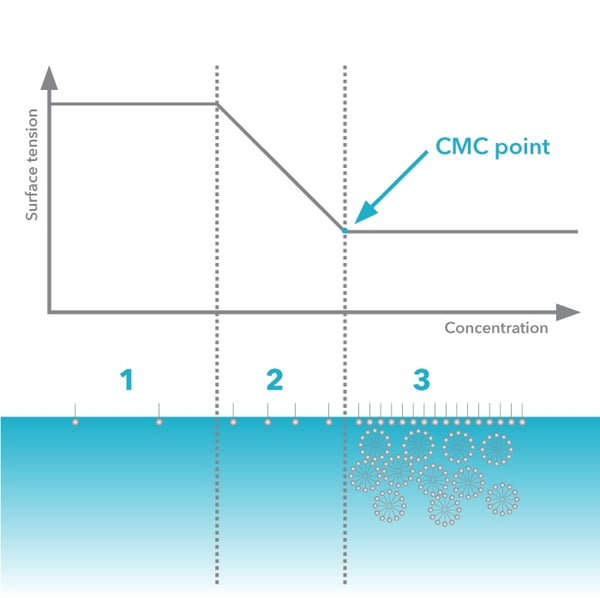
Surface tension is the most widely used method for CMC determination. The measurement principle maps directly onto what the CMC represents: as surfactant concentration increases, surface tension drops as molecules adsorb to the interface. Once the interface is saturated, surface tension levels off and the CMC appears as the breakpoint between the two regions.
The method works across different surfactant types and the result is a curve you can read directly. In practice, surface tension is measured using a force tensiometer with a Wilhelmy plate or Du Noüy ring.
How to measure CMC with a force tensiometer
To measure CMC, you run surface tension measurements across a concentration series that spans both sides of the expected CMC, typically two to three orders of magnitude, and log-spaced to get enough data points where the curve changes most steeply.
At each concentration, a Wilhelmy plate or Du Noüy ring is brought into contact with the liquid surface. For surfactant measurements, the Wilhelmy plate is generally preferred (see our guide on choosing between the Wilhelmy plate and Du Noüy ring). The probe measures the force at the liquid surface, which the instrument converts to a surface tension value. One thing to keep in mind is equilibration: the surface needs time to stabilize at each concentration before the reading is taken, and how long that takes depends on the surfactant.
The result is a surface tension vs. concentration curve plotted on a log scale with a declining region, a breakpoint, and a plateau. The CMC is read from the intersection of two fitted lines, one through the declining region and one through the plateau.
Automated CMC measurement with Sigma CMC
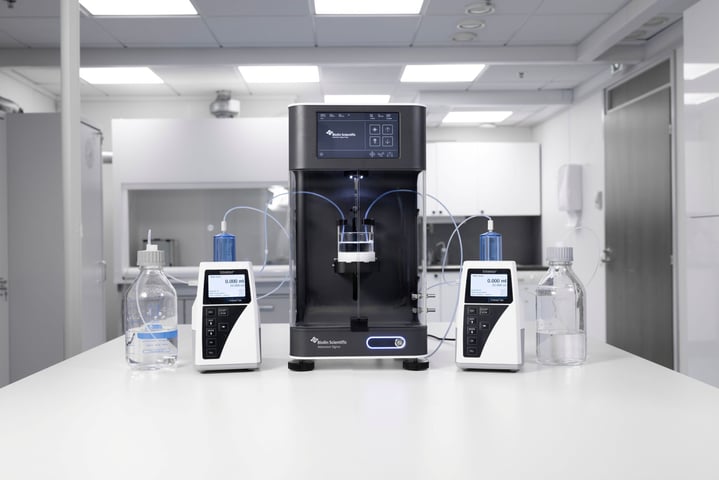
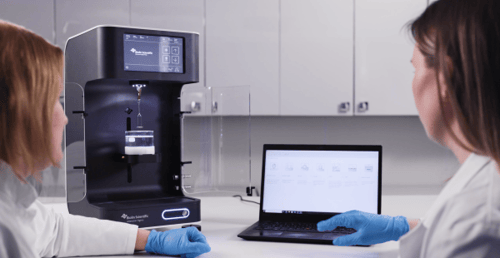
Sigma CMC is a force tensiometer that comes with two dispensers, designed specifically for automated CMC measurement. You define your concentration range, the number of measurement points per decade, and the stirring and equilibration times. The instrument then works through the series without further intervention — dispensing, stirring, waiting, and measuring at each step. As it detects the drop in surface tension that signals the CMC region, it automatically increases measurement density there to capture the breakpoint accurately.
The two-dispenser setup keeps the volume in the measurement vessel constant throughout the measurement series: one dispenser adds water while the other removes liquid at the same rate. You start with a concentrated surfactant solution in the vessel, and the system dilutes it in steps down past the CMC. This means less surfactant solution is needed overall, and switching between samples is straightforward.
The software both fits the CMC curve and returns the CMC value automatically. Because each step follows the same timing and sequence, the measurement is consistent run to run and there is minimal variance from operator to operator.
The video below shows how critical micelle concentration can be measured automatically with Sigma CMC.
Practical tips for reliable results
Start with a realistic concentration range. If you are measuring an unfamiliar surfactant, begin with a broader range than you think you need. A tight range that misses the transition entirely is far more costly than one that wastes a few low-concentration points. Literature CMC values for structurally similar surfactants are a reasonable starting estimate.
Use the highest practical purity grade. CMC is sensitive to surface-active impurities. Technical-grade surfactants may show artefacts in the curve that reflect contamination rather than the surfactant itself. For reference characterization or publication-quality data, use the highest purity grade available.
Clean the probe before each session. Contamination on a platinum Wilhelmy plate affects your surface tension values. After rinsing the plate with appropriate solvents and deionized water, heat the plate briefly in a high temperature flame until it glows, then allow it to cool and measure.
Clean measurement vessels carefully. Any residual surfactant from previous measurements will affect your results, so wash your beaker thoroughly with appropriate solvents and rinse with deionized water before each use.
Allow adequate stirring and equilibration time. Longer-chain and higher-molecular-weight surfactants are slower to equilibrate, so they need more time at each step. The equilibration time parameters can be adjusted to suit your specific system.
Control and report temperature. CMC is temperature-dependent. Report your measurement temperature, it is essential context for comparison with literature values or between batches.
Learn more
Join our webinar on November 4, 2026 to learn how Attension Sigma Peak force tensiometer can be used for surfactant analysis.