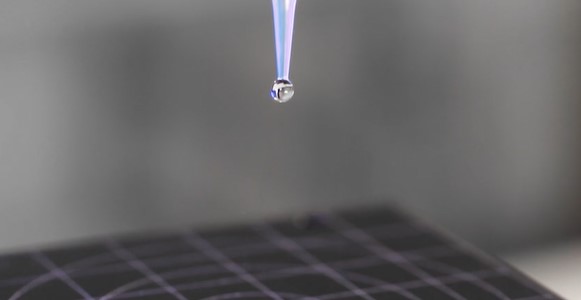
The pendant drop method measures surface and interfacial tension from the shape of a drop hanging from a needle. Surface tension tries to keep the drop round, while gravity pulls the drop into a teardrop shape. By analyzing the drop shape, an optical tensiometer calculates surface tension, using only a few microliters of sample.
You may already be familiar with the force-based methods, the Du Noüy ring and the Wilhelmy plate. If you'd like to compare all three, see our article 3 ways to measure surface tension. Here, we take a closer look at the pendant drop method: how it works, what to pay attention to for reliable results, and when it's the right choice for your samples.
How does the pendant drop method work?
Surface and interfacial tension measurements can be performed optically using pendant drop shape analysis. The idea behind the method is simple. A drop is formed at the tip of a needle and imaged against a backlight. Two forces shape the drop: surface tension pulls it toward a sphere, and gravity stretches it downward. The balance between them gives the drop its characteristic teardrop shape, and that shape tells you how high the surface tension is.
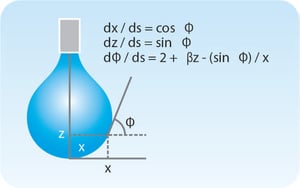 Surface or interfacial tension can be related to the drop shape by the equation;
γ = ΔρgR20/β
where γ is surface or interfacial tension, Δρ is the density difference between the drop and the surrounding phase, g is the gravitational constant, R0 is the drop radius of curvature at the apex and β is the shape factor obtained from the fit.
Note that the density difference is part of the calculation: for a correct result, you need to know the densities of both phases. Also, the size of the droplet used in the measurement is important as the drop should be large enough to form a tear or a pendant shape.
To read about why drops take the shape they do, see our article Shape of a water drop in air and on surface.
Surface tension measurements
When you measure surface tension, the drop hangs in air. A liquid is so much denser than air that even a small drop takes on a clear teardrop shape, and drop volumes of 5–20 µl are generally enough.
Interfacial tension measurements
To measure interfacial tension, a drop of one liquid is formed inside another, immiscible liquid in a cuvette. The density difference is now much smaller, so you'll usually need a larger drop. How large depends on both the density difference and the interfacial tension, but as a rule of thumb, the smaller the density difference, the larger the drop.
Sometimes the drop phase is lighter than the surrounding liquid, for example when you measure oil in water. The drop then rises instead of hanging, so it is formed with a hooked needle pointing upward. This variation is often called the rising drop method.
How do you get reliable results?
The accuracy of a pendant drop measurement depends mainly on the shape of the drop. The closer the drop is to a sphere, the less information its shape carries and the less accurate the result. These practices help:
- Use a large enough drop. The drop should have a clear teardrop shape. A good rule is to use the largest drop that still hangs stably from the needle.
- Choose the right needle. The needle should not distort the drop shape. The suitable outer diameter depends on the ratio of surface tension to density difference, so liquids with a high ratio need a larger needle.
- Enter correct densities. The result is directly proportional to the density difference, so an error in density causes an error of the same size in the surface tension. Use density values at the measurement temperature.
- Give surfactant solutions time. Surfactant molecules need time to move to the newly formed surface, so the surface tension decreases until it reaches equilibrium. Follow the value over time instead of reading it once.
- Control the environment. Surface tension depends on temperature, so measure at a known, stable temperature. Vibrations and air currents can disturb the drop.
- Keep everything clean. Even small amounts of contamination can lower surface tension. A clean needle and syringe, or a disposable tip, avoid carry-over between samples.
Benefits and limitations of the pendant drop method
The pendant drop method is especially useful when sample volumes are small, samples are difficult to handle, or surface tension is measured together with contact angle.
Benefits
- Small sample volume. Required sample volumes range from 5-10 to a few dozen microliters, while force tensiometer measurements need sample volumes in the milliliter range. This matters for biological, expensive or hazardous samples.
- No measurement probe. The result does not depend on the geometry or wetting of a ring or plate, which must be kept clean and undamaged in force-based methods.
- Easy handling of difficult samples. With disposable tips, contaminating samples such as paints and adhesives can be measured without cleaning a probe and sample vessel afterward.
- Suited to surfactant solutions. The surface is not stretched during the measurement, so the approach to equilibrium can be followed over time.
- Combines with contact angle measurements. An optical tensiometer measures both surface tension and contact angle, which makes it a versatile tool for solving wettability problems. Surface tension of a probe liquid can also be checked before it is used for contact angle measurements.
- Measurements in controlled conditions. Using different kind of environmental chambers, measurements can be performed at controlled temperatures and pressures.
Limitations
- Densities must be known. The density difference between the two phases is needed to calculate the result.
- Very low interfacial tensions are difficult. When the drop cannot form a stable, clearly non-spherical shape, accuracy suffers.
- Some standards require force-based methods. Many standards for surface tension specify the Du Noüy ring or Wilhelmy plate method.
- Automated CMC measurements are easier with a force tensiometer. For more, see our article How to measure CMC.
For help choosing between an optical and force tensiometer, see our article Optical tensiometer vs. force tensiometer.
Which standards cover the pendant drop method?
Most surface tension standards are based on force tensiometry, but the pendant drop method is standardized in the ISO 19403 series for paints and varnishes:
- ISO 19403-3:2024 specifies how to measure the surface tension of liquids with the pendant drop method. It applies, for example, to liquid coating materials, with restricted applicability for liquids with non-Newtonian flow behavior.
- ISO 19403-4:2024 specifies how to determine the polar and dispersive fractions of a liquid's surface tension from an interfacial tension measured with a pendant or rising drop.
For an overview of standards for both force and optical tensiometers, see Standards for tensiometers.
Pendant drop measurements with Attension tensiometers
Attension Theta optical tensiometers measure surface and interfacial tension with the pendant drop method, as well as contact angle. A disposable tip dispenser is available for contaminating samples, and hooked needles allow rising drop measurements. In OneAttension software, an acceptable surface tension range can be set for a probe liquid, so its purity is checked automatically before a contact angle measurement. For measurements at elevated pressures and temperatures, Attension Theta High Pressure is available, and a pulsating drop module extends the instrument to interfacial rheology.
Learn more about surface and interfacial tension
Download our white paper below to learn how surface and interfacial tension are measured, and what the benefits and limitations of each method are.