Have you ever applied a fresh coat of paint or a high-quality ink only to watch it bead up like water on a waxed car? Or perhaps the result looks fine initially, but the paint peels off the moment it dries?
If your paint or ink is peeling, the underlying cause is a failure of adhesion: the liquid never truly bonded to the material beneath it. In the world of coating and printing, the key to a perfect finish is not just the quality of your liquid but also the wettability of your surface.
Wettability is the ability of a liquid to maintain contact with a solid surface. This is determined by the balance of two forces:
For a paint or ink to wet a surface properly and form a bond that won't peel, the adhesive forces need to dominate. In practice this means that the surface energy of the material (which pulls the liquid outward) needs to be significantly higher than the surface tension of the liquid (which holds the liquid together).
Related reading: Understanding cohesion and adhesion
If your coating isn't peeling but is instead forming droplets, you are looking at poor wetting in real time. Common causes include:
If you are struggling with your paint peeling, crawling or beading up, consider these steps to improve adhesion:
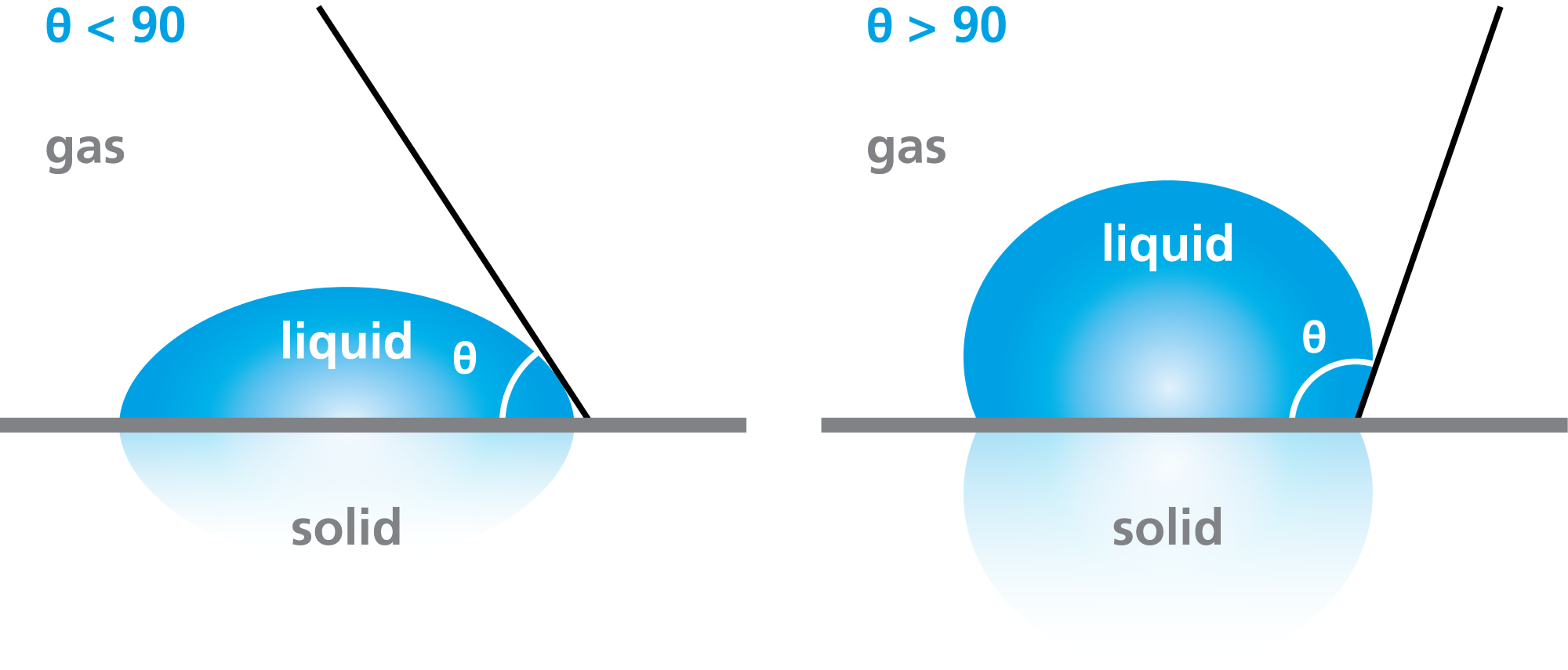
Once you have cleaned or treated your surface, how do you know it is actually ready? The most reliable way to predict if your paint will adhere to the surface is by measuring contact angle, the angle formed where a liquid meets the solid surface.
As a predictive quality control tool, this simple measurement allows you to evaluate surface cleanliness and treatment efficiency.
Low contact angle (less than 90°): The liquid spreads well (good wetting/adhesion)
What liquid should I use to measure the contact angle?
In the industry, both standard liquids and actual coatings are used. Water is the standard for checking if a surface is truly clean or if a treatment (like plasma or corona) successfully raised the material's surface energy. Testing with your actual paint or ink helps you see exactly how your specific formulation will wet and interact with the substrate.
Is cleaning the surface enough, or do I always need a surface treatment?
Cleaning and treating the surface do two different things. Cleaning removes physical barriers like dust, oils, or mold-release agents, so the paint can reach the material. However, if the underlying material naturally has low surface energy (like many plastics), cleaning alone won't make it stick. You will still need a treatment (like plasma or flame) to physically alter the chemistry and raise the surface free energy.
How long does a surface treatment last before I need to apply the paint?
Surface treatments are not permanent. Processes like corona or plasma treatment temporarily "excite" the surface molecules to raise surface free energy, but this effect degrades over time, a process called "aging". Depending on the material and storage conditions, you may have anywhere from a few hours to a few weeks to apply the coating. Contact angle measurements can be used to determine the acceptable time window between treatment and coating.
Tired of dealing with peeling paint or inconsistent ink bonding? Download our comprehensive white paper below to learn how contact angle measurements can be used to predict adhesion and bonding.

Anna Junnila is Customer Care Manager at Biolin Scientific. She takes pride in making advanced technology accessible for every user and is committed to guiding customers through every stage of their research journey. She holds an MSc in Electronics and Electrical engineering from Aalto University.





.jpg?width=160&name=anna%20junnila%20(resized-1).jpg)