Environmental technologies often succeed or fail at the interface. Processes such as contaminant adsorption, membrane fouling, particle deposition, biofilm formation and cleaning response occur where liquids meet membranes, sorbents, coatings, particles or biological layers. These processes can strongly influence performance, durability, selectivity and cleanability.
QSense QCM-D helps analyze these processes in real time by tracking changes in frequency and dissipation at a sensor surface. These measurements provide insight into mass uptake, layer buildup, removal and the mechanical character of interfacial layers — helping researchers and technology developers understand what happens at surfaces and interfaces under relevant conditions.
Many environmental solutions are built around interactions at solid–liquid interfaces. In water purification, contaminants must be captured or rejected by membranes, sorbents or coatings. In desalination and membrane filtration, foulants and scale-forming compounds accumulate at membrane surfaces. In PFAS remediation, adsorption to engineered materials determines how effectively contaminants are captured. In microplastic and nanoparticle studies, deposition and release depend on interactions with mineral, organic or biofilm-coated surfaces.
These same interfaces can also be where performance problems begin. Unwanted adsorption, particle aggregation, fouling layer formation or biofilm growth can reduce efficiency, shorten material lifetime and make cleaning more difficult.
To improve environmental technologies, it is therefore not enough to measure only the final outcome. Researchers also need to understand how interfacial processes develop over time.
At environmental interfaces, several dynamic processes may occur:
These events are often influenced by experimental conditions such as pH, salinity, water chemistry, surface chemistry, contaminant concentration, additives and cleaning protocols. Because the processes are dynamic, time-resolved measurements are valuable for understanding not only what happens, but when and how it happens.
QCM-D, or Quartz Crystal Microbalance with Dissipation monitoring, is a surface-sensitive technique that measures changes in resonance frequency and dissipation at a sensor surface. A change in frequency provides information about material coupling to or leaving the surface, while dissipation provides insight into the mechanical or viscoelastic character of the layer.
The value of QCM-D lies not only in measuring whether material adsorbs, but in showing how interfacial behavior develops over time. As illustrated in Figure 1, the same QCM-D experiment can be analyzed in complementary ways to reveal adsorption dynamics, mass uptake, layer properties and structural evolution.
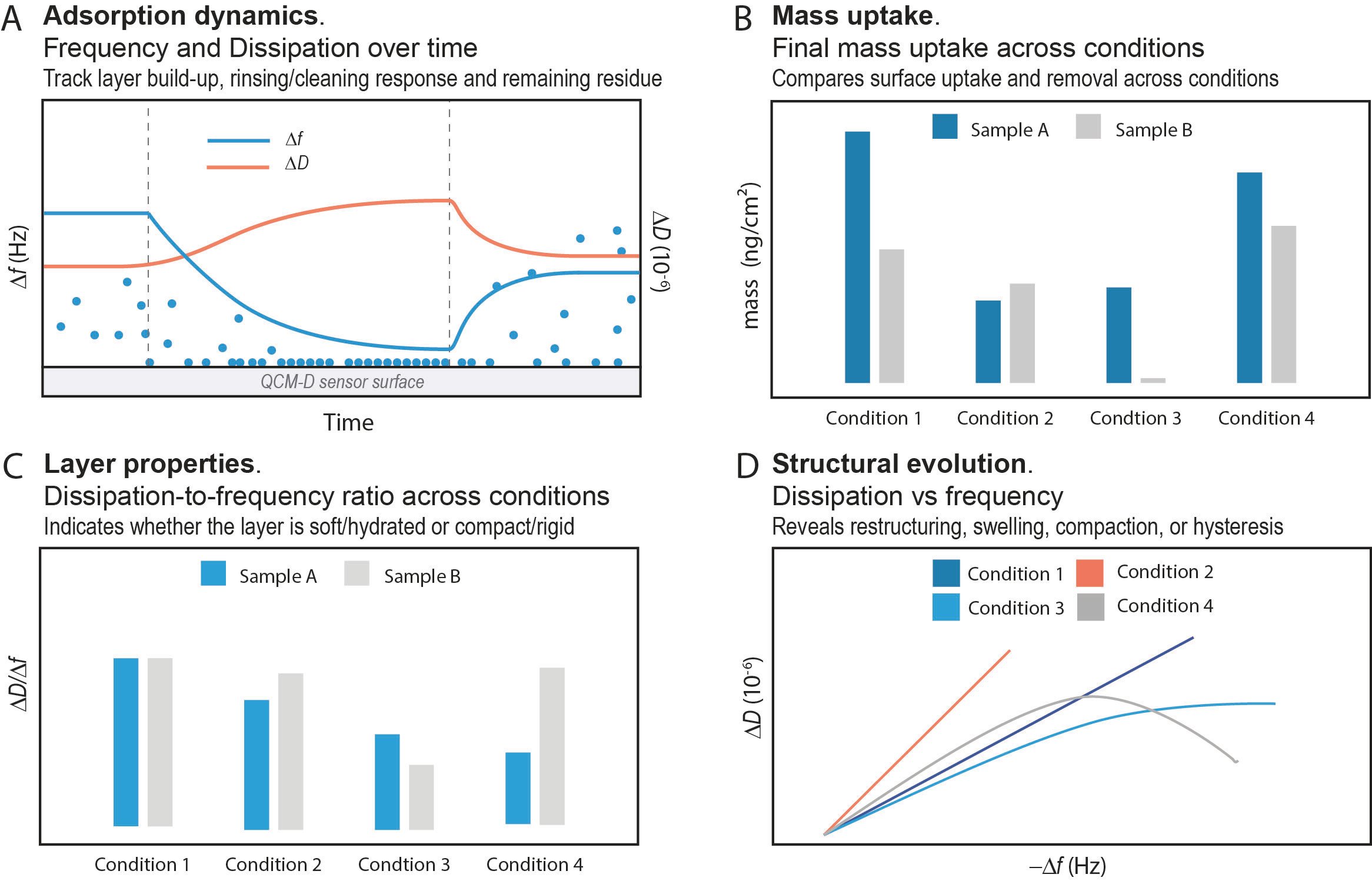
Figure 1. From QCM-D data to interfacial insight. Frequency and dissipation data can be used to follow adsorption dynamics, compare mass uptake across conditions, evaluate layer softness or rigidity, and detect restructuring, swelling, compaction or hysteresis at environmental interfaces.
In practical terms, QCM-D can help answer questions such as:
By converting interfacial events into measurable data, QCM-D helps connect surface-level mechanisms to material performance and process design.
QSense QCM-D can be used to study interfacial behavior across a broad range of environmental applications, including:
Across these areas, QCM-D is useful because it makes interfacial processes visible, measurable and comparable under controlled conditions.
As shown in Figure 1, QCM-D data can be analyzed in complementary ways depending on the question being asked. Frequency and dissipation over time reveal adsorption dynamics, layer buildup, rinsing or cleaning response and residual material. Final mass uptake can help compare adsorption capacity, contaminant affinity, removal efficiency or sorbent performance across different conditions. Dissipation-to-frequency analysis provides insight into whether an interfacial layer is relatively soft and hydrated or more compact and rigid, while dissipation versus frequency plots can indicate whether adsorption involves restructuring, compaction, swelling or hysteresis.
Together, these analyses help turn real-time surface measurements into mechanistic insight that can support material selection, sorbent design, fouling control, cleaning strategies and environmental fate studies.
QCM-D data are not limited to a single endpoint. The same experiment can show how quickly material adsorbs, how much remains after rinsing or cleaning, whether the layer is soft or compact, and whether the adsorption pathway changes over time. This makes QCM-D useful for studying environmental processes such as fouling, contaminant sorption, particle deposition and biofilm formation — and for connecting interfacial behavior to material performance and process design.
To learn more about QSense analysis in these applications, download the overview below.

Malin graduated in engineering physics in 2006, where her research focused on the QCM-D technology. Since then, she has been scrutinizing the how’s and why’s of the world in general, and the world of QCM-D in particular.