PFAS remediation is one of the clearest examples of why surface and interfacial processes matter in environmental science. Per- and polyfluoroalkyl substances, or PFAS, are persistent, structurally diverse contaminants, and many approaches to their removal depend on how these molecules interact with sorbents, membranes, coatings, or sensor surfaces. But PFAS is not an isolated case. Across environmental technologies — from water purification and membrane filtration to microplastic deposition and biofilm control — performance is often governed by what happens at solid–liquid interfaces. This is why understanding interfacial behavior is essential, not only for fundamental research, but also for developing more effective environmental technologies.
For adsorption-based PFAS remediation, removal depends on more than whether a material can capture PFAS. Different PFAS compounds can interact differently depending on molecular structure, chain length, head group, charge distribution, and size. At the same time, surface properties such as hydrophobicity, charge, polarity, and available functional groups influence adsorption strength, selectivity, and reversibility.
This makes PFAS adsorption a structure- and surface-dependent process. A material that shows strong uptake for one PFAS may behave differently for another. Likewise, a surface that promotes adsorption may not necessarily support efficient desorption or regeneration. To design better sorbents and functionalized surfaces, we need to understand the mechanisms behind the observed performance.
QCM-D (Quartz Crystal Microbalance with Dissipation Monitoring) provides a way to follow PFAS–surface interactions in real time. By monitoring changes in frequency, ∆f, and dissipation, ∆D, at a coated sensor surface, QCM-D can provide insight into mass uptake, adsorption kinetics, desorption behavior, and changes in the interfacial adlayer, Fig 1.
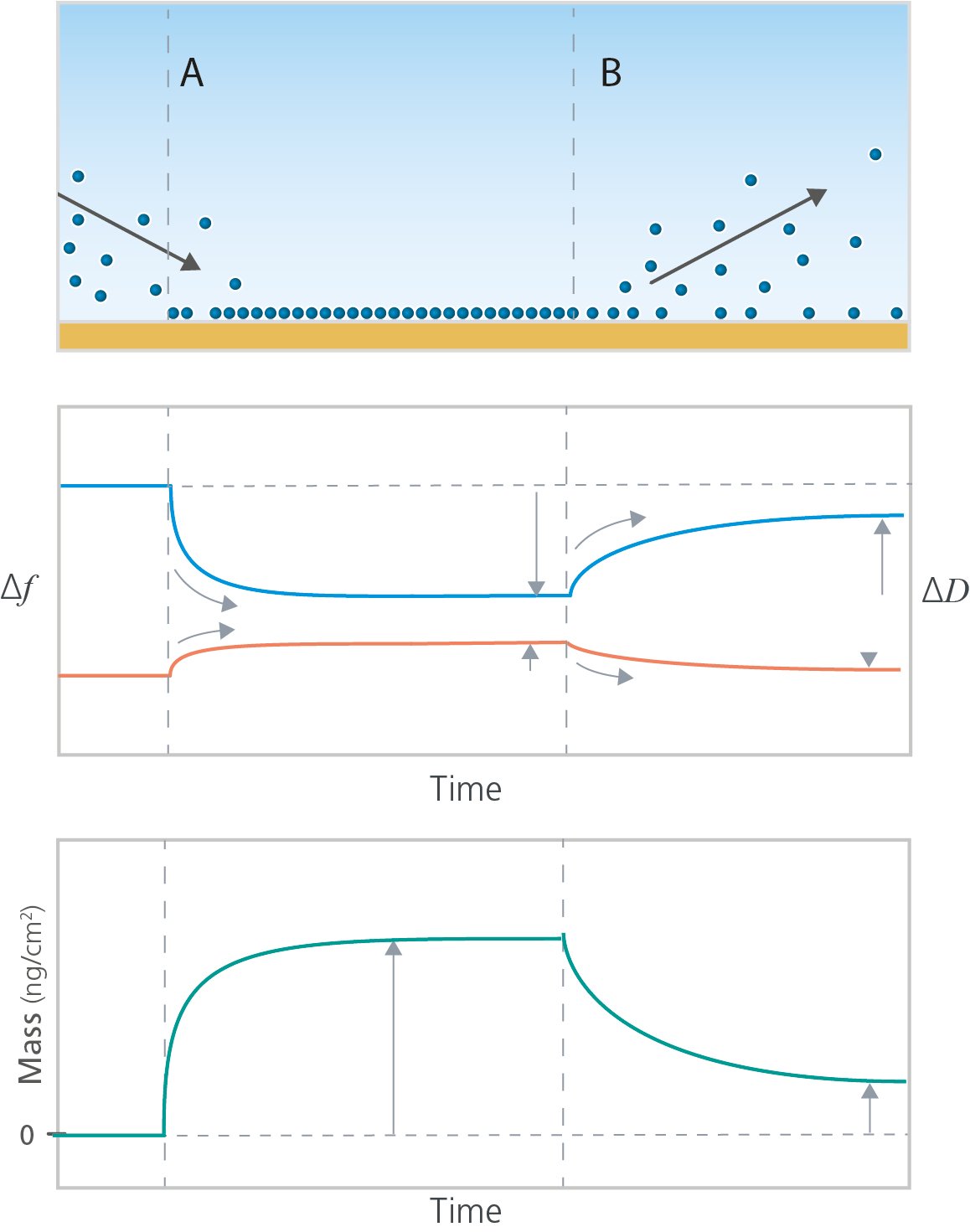
Figure 1. Schematic illustration of a QCM-D measurement of molecular adsorption and desorption at a sensor surface. A negative frequency shift, Δf, is typically associated with mass uptake, while an increase in frequency can indicate mass removal. The dissipation shift, ΔD, tracks changes in energy loss and gives insight into the mechanical/viscoelastic character of the layer.
In PFAS studies, sensors can be modified with model surface chemistries, functionalized coatings, or sorbent-like interfaces. This makes it possible to compare how different surface properties influence PFAS adsorption under controlled solution conditions. Rather than measuring only a final removal value, QCM-D allows us to observe how adsorption develops over time, whether the interaction is reversible, and how the response changes between different PFAS compounds or surface chemistries, Fig. 2.
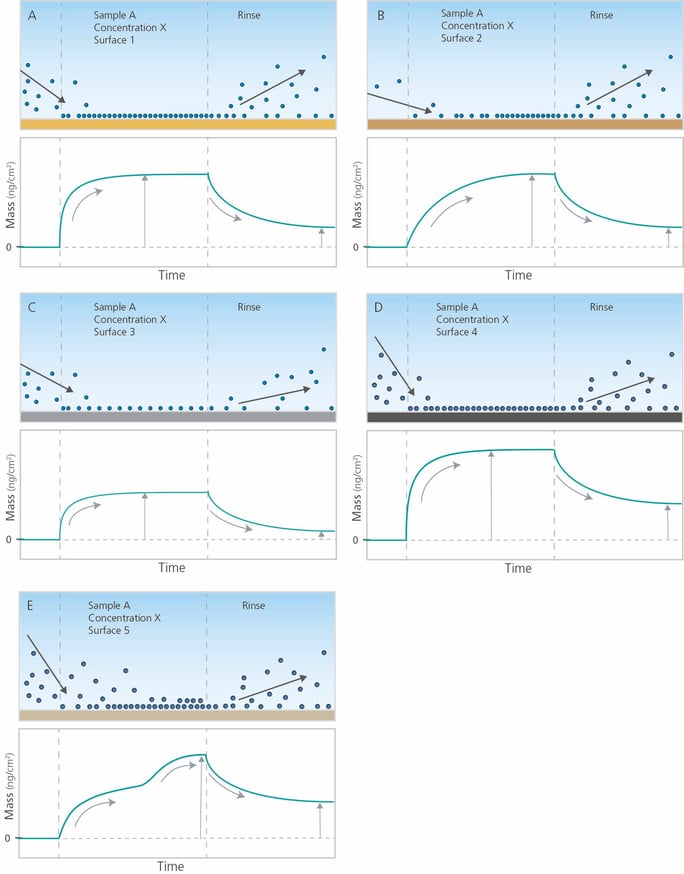
Figure 2. Comparing interfacial behavior across different surfaces. Schematic illustration of how QCM-D can be used to compare the performance and behavior of different surface materials under identical experimental conditions. In this example, the same sample and concentration are applied to five different surfaces while all other parameters are kept constant. The time-resolved mass curves reveal differences in adsorption rate, total mass uptake, removal during rinsing and residual mass remaining at each surface.
In our work, we have used QCM-D to study how different PFAS interact with engineered model surfaces. By designing surfaces with different interfacial properties, we can begin to isolate how factors such as hydrophobicity and electrostatic interactions contribute to adsorption.
This model-surface approach helps simplify a complex environmental problem. Real water treatment systems involve many variables at once, including mixtures of contaminants, ions, organic matter, and changing operating conditions. Model surfaces allow us to probe select PFAS-surface interactions on a controlled platform and build mechanistic understanding that can later inform more applied sorbent or treatment studies.
For PFAS, this is especially important because molecular structure plays a predominant role in adsorption. Chain length, functional group, and charge distribution can all influence how PFAS interact with a surface. QCM-D helps connect these molecular and surface properties to measurable adsorption behavior, supporting the development of structure–property relationships and guiding the rational design of adsorbent materials for PFAS remediation.
Although PFAS is the focus of the work we do in our research group, the underlying challenge is much broader. Many environmental technologies depend on interfacial processes that are difficult to understand or remain convoluted from bulk measurements alone.
For example, in membrane filtration, we need to understand how foulants adsorb, reorganize, and remain after cleaning. In micro- and nanoplastic studies, deposition and release depend on particle properties, surface chemistry, and water chemistry. In wastewater treatment, biofilm formation and extracellular polymeric substances influence both treatment performance and fouling.
Across these areas, QCM-D enables the translation of dynamic surface behavior into measurable data. This can help researchers connect fundamental interfacial mechanisms to practical questions in material selection, remediation, fouling control, and process optimization.
PFAS remediation is one example of how environmental technologies depend on what happens at interfaces. To explore the broader role of QCM-D in environmental research and technology development, download the overview below which explains what QSense QCM-D measures, how QCM-D data can be interpreted and how time-resolved interfacial measurements are used across environmental applications — including PFAS adsorption and sorbent screening, membrane fouling, micro/nanoplastic deposition and biofilm formation.
Download the overview to learn how QCM-D helps make interfacial behavior visible, measurable and useful for environmental research and technology development.

McKenna Dunmyer, MS, is a guest writer and PhD candidate at the University of Arizona with expertise in environmental contaminants, interfacial phenomena, and QCM-D. Her research investigates how PFAS interact with engineered surfaces and biomimetic membrane models to better understand contaminant fate, transport, remediation, and exposure risks. Through her work, she integrates QCM-D with advanced modeling approaches to resolve the molecular-scale processes governing contaminant behavior at environmental and biological interfaces, linking surface-level interactions to broader questions in environmental health and remediation.