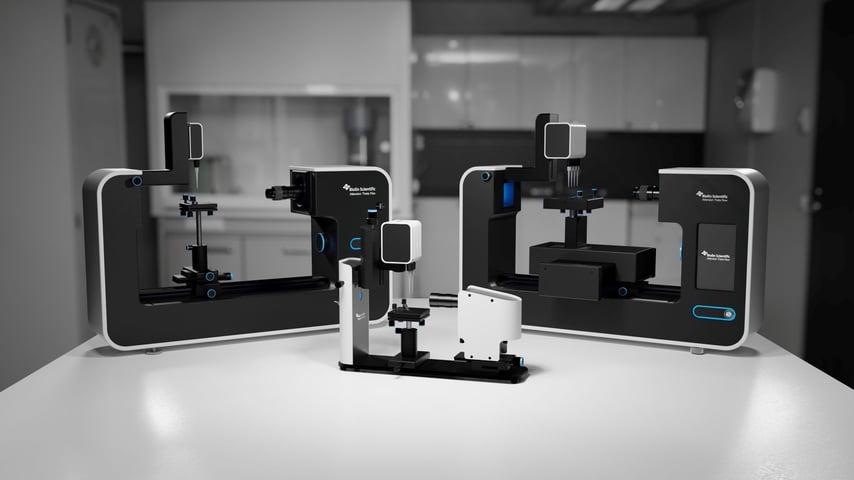
Optical tensiometers, also called contact angle meters, goniometers or drop shape analyzers, range from under $5,000 for basic manual instruments, which typically measure static contact angle and sometimes pendant drop surface tension, to $100,000 or more for fully automated systems with automated dispensers, temperature control and other accessories.
The range reflects real differences in what the instruments can do. This post looks at the main factors behind it, and at why software has a particularly large influence on what an optical tensiometer costs you to own.
What affects the price of an optical tensiometer?
Most of the price difference comes from the imaging and dispensing hardware, the level of automation, the accessories required and the software:
- Camera and optics. Higher resolution, faster frame rates and a well-matched field of view make it possible to analyze small drops, low contact angles and fast-spreading liquids — and they add to the price.
- Dispensing. A manual syringe costs less than an automated dispenser. Multi-liquid dispensers, useful for surface free energy measurements, and small-volume options add further cost.
- Automation. Motorized stages, automated tilting and automated dispensing reduce hands-on time but raise the purchase price.
-
Hardware for specific measurements. Many measurements, such as static contact angle and pendant drop surface tension, can be done with a basic setup. Others need additional hardware: i.e. roughness-corrected contact angle requires a module that measures surface topography, and tilting-based dynamic contact angle measurements need a tilting stage.
- Accessories. Temperature and humidity control, high-pressure chambers and special sample stages, for example for large wafers, are usually priced separately and can add considerably to the instrument purchase price.
- Software. The licensing model, and whether all measurement modes are included, affect the price at purchase and over time.
Costs beyond the purchase price
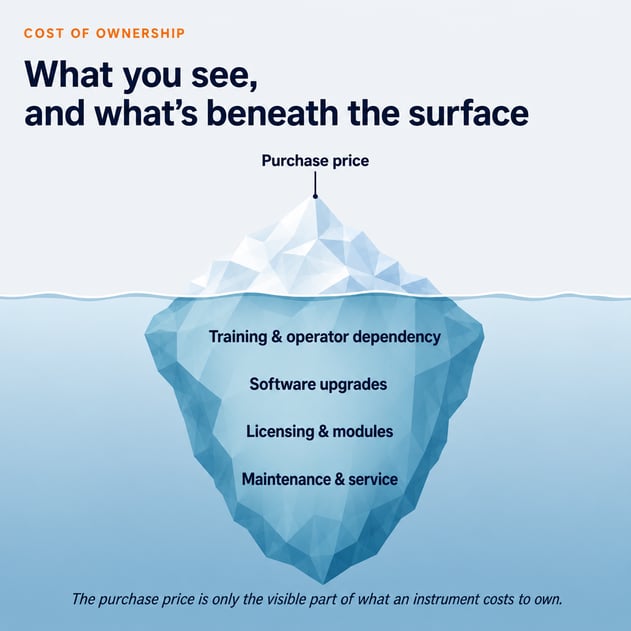
The purchase price covers the instrument as delivered. What you pay over the instrument lifetime also depends on how the software is licensed, what maintenance the system needs and how much effort it takes to train and support users:
- Software licensing.
Some suppliers license software per computer, per user or by subscription. Others allow installation on an unlimited number of computers, so colleagues can review and analyze data at their own computer without extra licenses.
- Measurement modules.
Some suppliers sell measurement modes as separate software modules. Others include all modes from the start, so expanding your measurements doesn't add software cost.
- Software upgrades.
If upgrades are included, your software cost is fixed at purchase. If they're charged separately, each new version needs its own budget, and support for older versions may eventually end.
- Training and operator dependency.
Every new user needs training. Less intuitive software means longer training and more variation in results between operators.
- Maintenance and service.
Calibration, service contracts and response times vary between suppliers. If you use the instrument daily, downtime after a fault can cost more than the repair itself.
How software affects your time, results and costs
In an optical tensiometer, software does more than control the instrument: it analyzes the drop images and calculates the results. How much of that analysis happens automatically, how easy the software is to use and how it is licensed all affect what the instrument costs you in practice.
-
Automated analysis. When results are analyzed automatically, every measurement is evaluated the same way, whoever runs it. This saves time and keeps results comparable between operators. Manual adjustment still has its place, for example with challenging samples, but the less of it routine measurements need, the more repeatable your results will be.
-
Intuitive software. Clear menus and workflows shorten the time it takes a new user to produce reliable results. In a lab with several users, or with frequent changes in personnel, this saves time on training and support, and helps keep results consistent between people.
-
Licensing model. The licensing model determines how widely the software can be used. If it can be installed on any number of computers, colleagues can review and analyze data at their own desks without tying up the instrument or waiting for an extra license. Per-computer or per-user licensing limits this, or adds cost each time a computer or user is added.
Together, these make software one of the most important things to evaluate before buying, for the time you spend, the repeatability of your results and the long-term cost of ownership.
When automation is worth the extra cost
Automated features add to the purchase price, but they save you measurement time at the instrument and reduce repeat measurements.
-
Automated dispensers deposit drops of consistent volume, removing a common source of variation.
-
Motorized stages and batch measurements let you measure several points or samples without constant attention.
-
Saved measurement recipes and guided workflows help different users run the same measurement the same way.
If you're a single experienced user measuring a few samples, manual operation may be enough. The more samples and operators you have, the more automation pays off.
Can you start small and upgrade later?
If your budget is limited, a modular instrument can be a good starting point: you buy the configuration you need today and add automation and accessories as your needs grow, without replacing the whole instrument. Before buying, it's worth asking which upgrades are possible on the model you're considering, and whether the software already supports the measurements you might add later.
Questions to consider when setting a budget
There's no single correct price point. The least expensive instrument that covers your measurements isn't necessarily the least expensive to own, and the most capable one isn't necessarily the best fit. These questions help you define what your lab needs:
- How often will the instrument run, and how many people will operate it?
Higher usage and more operators make automation and consistent analysis worth more.
- Which measurements do you need now, and which might you need later?
Separately sold software modules or a closed hardware platform can make later needs expensive.
- Will colleagues review or analyze data away from the instrument?
If so, check how the software is licensed on additional computers.
- How much time can you dedicate to training?
Intuitive software and guided workflows shorten training for every new user.
- What's your budget over the instrument's lifetime, not just at purchase?
Software upgrade fees, consumables and service contracts belong in the comparison, not just the purchase price.
With these answers ready, you can compare different instruments on the costs that matter for your lab, rather than on list price alone.