Bio-based surfactants are surface-active materials made wholly or partly from renewable biological resources. Biosurfactants are a more specific group: surface-active compounds produced by microorganisms such as bacteria, yeasts, and fungi.
Both can influence how liquids behave at interfaces. Depending on the material and application, they can support wetting, emulsification, dispersion, foam formation, or solubilization. But a renewable origin alone does not determine performance. The relevant question is whether the material delivers the required behavior in the final application. [1]
Bio-based surfactants and biosurfactants at a glance
|
Bio-based surfactants
|
Surface-active materials made wholly or partly from renewable biological resources. |
|
Biosurfactants
|
Surface-active compounds produced by microorganisms. |
|
What they do
|
They can reduce surface or interfacial tension and support wetting, emulsification, dispersion, and solubilization. |
|
Where used
|
Cleaning, personal care, food, pharmaceuticals, coatings, packaging, remediation, and industrial processes. |
|
How assessed
|
Surface and interfacial tension, CMC, wettability, stability, and application tests. |
What are bio-based surfactants?
Surfactants are materials that accumulate at interfaces—the boundary between air and water, between two liquids such as oil and water, or between a liquid and a solid. They contain both hydrophilic and hydrophobic parts, allowing them to interact with water and nonpolar materials such as oils.
Bio-based surfactants are distinguished by the origin of at least part of their raw materials. Their starting materials may include plant oils, fatty acids, sugars, lignocellulosic fractions, and side streams from food, agricultural, or forestry processes.
They can be made through several routes. Some are synthesized from renewable feedstocks. Others are produced through microbial fermentation. This is why the term bio-based surfactant is broader than biosurfactant.
What are biosurfactants?
Biosurfactants are produced by microorganisms. Their structures vary widely, and this affects how they adsorb at interfaces, form micelles, stabilize emulsions, and perform under different conditions. [2]
Glycolipids
Glycolipids contain carbohydrate groups linked to lipid chains. Rhamnolipids and sophorolipids are among the best-known examples. They are widely studied for applications where surface activity, emulsification, and oil–water interactions matter.
Lipopeptides
Lipopeptides combine lipid chains with peptide structures. Surfactin, iturin, and fengycin are prominent examples. Their surface activity and biological interactions have made them relevant to areas including agriculture, food, and biomedical research.
Polymeric biosurfactants and bioemulsifiers
Higher-molecular-weight microbial surface-active compounds are often called bioemulsifiers. These materials can be particularly useful when emulsion stabilization is more important than achieving the lowest possible surface-tension value. [2]
Bio-based surfactants vs biosurfactants: what is the difference?
The terms are closely related, but they should not be used interchangeably. Biosurfactants are generally bio-based, but not all bio-based surfactants are biosurfactants. The distinction mainly comes down to their source and production route.
| Question |
Bio-based surfactants |
Biosurfactants |
|
Primary source
|
Renewable biological raw materials |
Microorganisms |
|
Production route
|
Extraction, chemical conversion, enzymatic processing, or fermentation |
Microbial fermentation |
|
Examples
|
Sugar- and fatty-acid-derived surfactants, lignin-based surface-active materials |
Rhamnolipids, sophorolipids, surfactin |
What are bio-based surfactants made from?
Bio-based surfactants can be developed from a wide range of renewable feedstocks. These include plant oils and fatty acids, sugars and carbohydrates, and materials derived from agricultural, food-processing, and forestry side streams.
Some bio-based surfactants are made by chemically or enzymatically converting renewable feedstocks into surface-active molecules. Others are produced through microbial fermentation. In these cases, microorganisms can use feedstocks such as waste oils, molasses, glycerol-containing streams, food-processing by-products, and agricultural residues as carbon sources for biosurfactant production. [1, 3]
Forestry-derived materials can also play a role. Lignin, for example, can be fractionated or modified to create amphiphilic materials that function as surfactants — lowering surface or interfacial tension in roles such as wetting agents or emulsifiers. [4] But not every lignin-derived material works this way. Lignin nanoparticles, for instance, are increasingly used to stabilize emulsions through a different mechanism: rather than adsorbing as individual molecules, they act as solid particles that physically anchor at the oil-water interface — a stabilization approach known as a Pickering emulsion. [5]
Regardless of the feedstock or production route, surfactant performance needs to be measured, which is where surface and interfacial tension, CMC, and wettability testing come in.
How do bio-based surfactants and biosurfactants work?
Surface-active materials accumulate at interfaces and change how liquids interact with one another or with a solid surface.
At an air–water interface, a surfactant can lower surface tension. This may influence wetting, spreading, foaming, and cleaning.
At an oil–water interface, it can lower interfacial tension. This can be important in applications involving emulsification, oil removal, dispersion of hydrophobic ingredients, or hydrocarbon mobilization.
At a solid–liquid interface, the material may influence wettability and adhesion. This can be especially relevant for coatings, paper and packaging, powders, porous materials, and wood-derived substrates.
The performance of a bio-based surfactant or biosurfactant depends on more than its source. Molecular structure, concentration, temperature, pH, salt concentration, the oil phase, and other formulation ingredients can all influence the final result. [6]
What are bio-based surfactants and biosurfactants used for?
|
Application area
|
Possible function
|
Relevant performance question
|
|
Cleaning and personal care
|
Wetting, soil removal, foaming, emulsification |
Does the material lower surface tension quickly and work in the complete formulation? |
|
Food, cosmetics, and pharmaceuticals
|
Emulsification, dispersion, solubilization |
Can it form or stabilize the intended oil–water system? |
|
Paper, packaging, coatings, and wood-based materials
|
Wetting, dispersion, coating uniformity, surface modification |
Does it improve wetting or control liquid interaction with the substrate? |
|
Environmental remediation
|
Mobilization, dispersion, or solubilization of hydrophobic contaminants |
Does it lower oil–water interfacial tension under realistic conditions? |
|
Industrial processes
|
Oil–water separation, dispersion, process control |
How does it perform at the relevant interface, temperature, and salinity? |
Further reading:
Biosurfactant – Environmentally friendly alternative for many industries
Biosurfactants in Bioremediation: The Sustainable Solution for Pollution Cleanup
How are bio-based surfactants and biosurfactants measured?
Bio-based surfactants and biosurfactants are typically characterized using surface tension, interfacial tension, critical micelle concentration (CMC), and contact angle. Other properties, such as adsorption behavior at surfaces (QCM-D) or emulsion viscoelasticity (interfacial rheology), can add complementary detail depending on your application.
Which measurement matters most depends on your material's intended application. A material developed to improve wetting on a solid surface calls for different assessment than one meant to stabilize an oil–water emulsion. Likewise, a promising result in pure water doesn't necessarily predict how the material will behave in your complete formulation or real process environment.
Surface tension
Surface tension describes the force acting at the surface of a liquid. Surfactants lower surface tension by accumulating at the air–liquid interface.
Surface-tension measurements can help you answer practical questions:
- Does your sample show surface activity?
- How does surface tension change as you increase concentration?
- Does performance stay stable after a change in pH, temperature, or salt concentration?
- Are your batches or formulations comparable?
Surface tension is often the most effective place to start when you're screening candidates or developing a formulation.
Interfacial tension
Interfacial tension describes the force at the boundary between two immiscible liquids, such as oil and water.
This measurement matters most when your target application involves emulsification, oil removal, hydrocarbon dispersion, oil recovery, or solubilization of hydrophobic ingredients. The relevant oil phase matters here, too — make sure your measurements reflect the real material or model system your formulation will actually encounter.
Critical micelle concentration (CMC)
The critical micelle concentration, or CMC, is the concentration above which surfactant molecules increasingly form micelles in solution.
When surfactant concentration increases, surface tension typically decreases until the air–water interface becomes saturated. Beyond this point, additional surfactant molecules increasingly form micelles rather than further lowering surface tension.
CMC helps you compare surfactants and identify an efficient concentration range for your formulation work:
- Effectiveness: How low can the surfactant lower surface tension?
- Efficiency: How much surfactant is required to achieve that reduction?
For a deeper explanation, see our article "What Is Critical Micelle Concentration (CMC)?".
Wettability and contact angle
If your material needs to interact with a solid surface, wettability can matter just as much as surface or interfacial tension.
Contact-angle measurement helps assess how a liquid spreads on a surface. This can be relevant when developing coatings, evaluating paper or packaging materials, studying wood-derived materials, or comparing surface treatments.
A lower contact angle generally indicates better wetting, although the desired result always depends on the application.
Why test under realistic conditions?
You should test bio-based surfactants and biosurfactants under conditions that resemble their intended use. This may include changes in:
- pH
- Temperature
- Salt concentration
- Co-solvents
- Oil phase
- Other formulation ingredients
- Sample age and storage conditions
The goal is not only to demonstrate surface activity. It is to understand whether the material will deliver the required performance in the actual formulation, process, or quality-control workflow.
Which measurement answers which question?
|
If you need to know…
|
Measure
|
What it helps reveal
|
| Does the sample lower air–water surface tension? |
Surface tension |
Surface activity and concentration response |
| At what concentration do micelles increasingly form? |
Surface tension versus concentration |
Critical micelle concentration |
| How does it behave between oil and water? |
Interfacial tension |
Emulsification, dispersion, or oil-mobilization potential |
| Does it wet the target substrate? |
Contact angle or related wettability measurement |
Liquid–solid interaction and spreading behavior |
| Does it remain functional in the real process? |
Surface or interfacial tension under controlled conditions |
Robustness across pH, temperature, salinity, and formulation changes |
Learn how to measure surfactant performance with Sigma Peak
If you want to learn how surface tension, interfacial tension, and critical micelle concentration measurements can support the development of bio-based surfactants and biosurfactants, join our upcoming online webinar on September 1st, 2026.
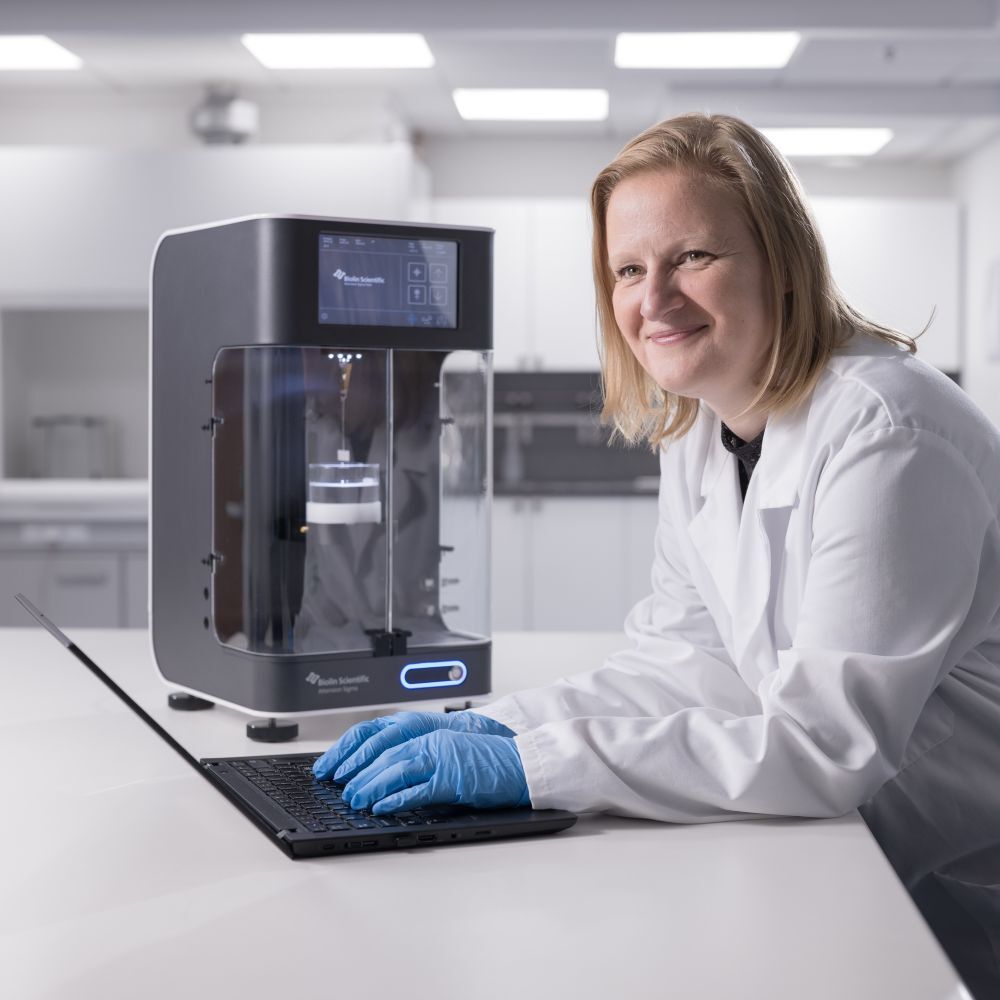
In the webinar, we will look at how the Attension Sigma Peak force tensiometer can help characterize surfactant performance and support efficient workflows for formulation development, material comparison, and quality control.







.jpg?width=160&name=anna%20junnila%20(resized-1).jpg)